
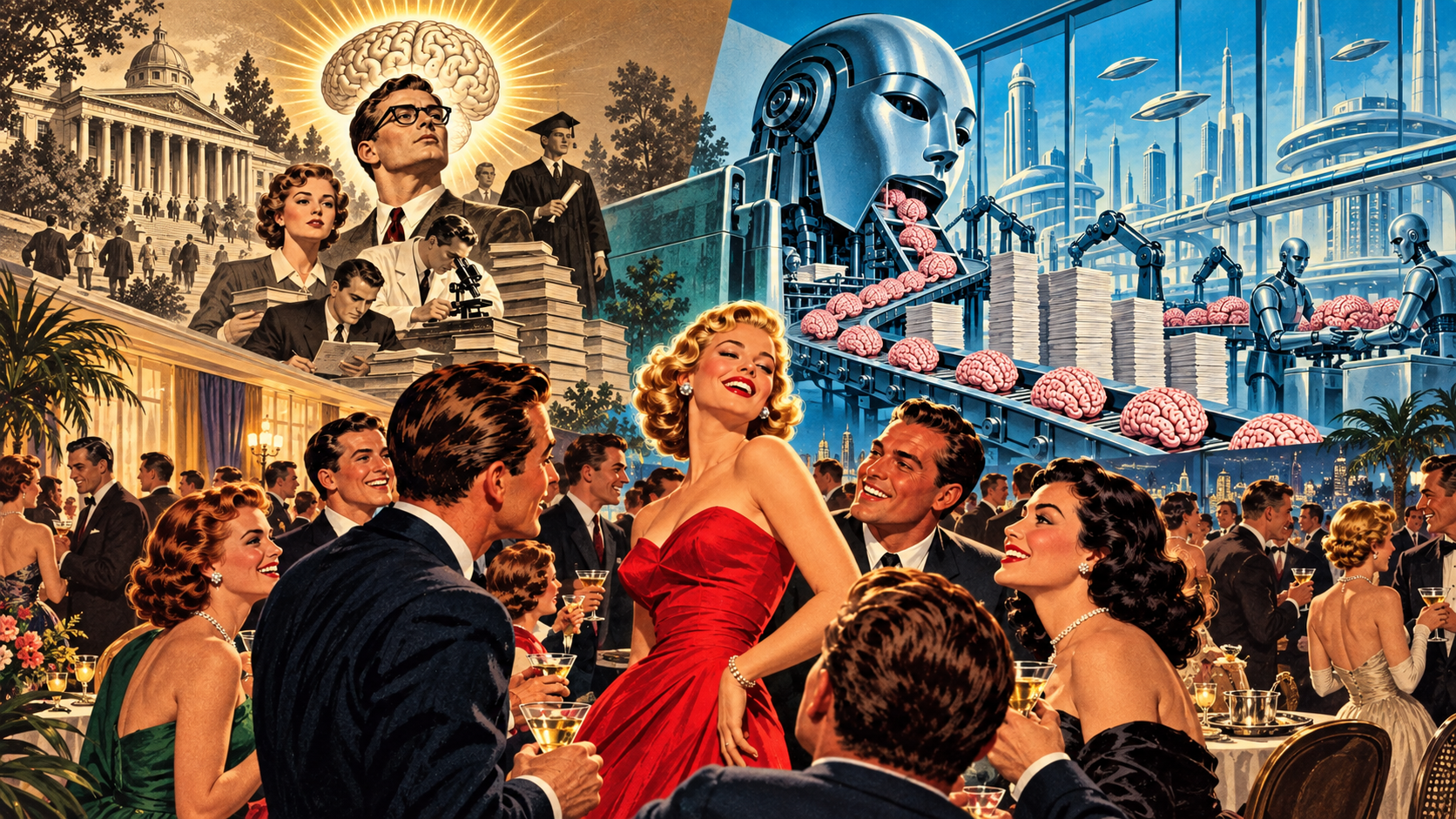
For most of the 20th century, advanced societies became increasingly good at finding intelligent people and giving them important things to do.
Schools sorted students by grades. Universities selected for academic performance. Professional schools filtered again. Corporations added interviews, aptitude tests, credentials and technical assessments. Science rewarded publication and citation. Engineering rewarded the ability to solve increasingly abstract problems.
It wasn't literally an IQ test. But the machinery pointed in roughly the same direction.
IQ itself is approximately normally distributed, conventionally centered around 100 with a standard deviation of 15. That means roughly 68% of people fall between 85 and 115. Around 16% score above 115. Around 2% score above 130.
Modern institutions created increasingly lucrative environments for that upper tail.
If you were unusually good at abstraction, symbolic manipulation, learning from text, holding complicated systems in your head and producing correct answers, the 20th century gave you more and more places to convert that ability into status and money.
You could become a physician, lawyer, engineer, scientist, programmer, analyst or executive.
This changed culture too.
We began to associate being useful with being cognitively impressive.
The smart kid was told to study harder. The successful adult was encouraged to keep learning, read widely, develop expertise, remain curious and reinvent themselves. Silicon Valley pushed this worldview even further: learn quickly, reason from first principles, teach yourself new fields, write code, absorb enormous quantities of information.
For people near the upper end of the cognitive distribution, this advice often works remarkably well.
There is only one problem.
We may now be automating a substantial fraction of the thing our institutions spent a century learning to reward.
AI has an unusually intellectual view of humanity
Talk to an advanced AI system for long enough and something becomes noticeable.
Its model of a competent person looks suspiciously like the worldview of a highly educated, verbally sophisticated knowledge worker.
Understand the evidence.
Clarify your assumptions.
Break the problem into pieces.
Read more.
Compare alternatives.
Write clearly.
Learn continuously.
Update your beliefs.
Think probabilistically.
These are good habits. But they are not a neutral sample of human competence.
They partly reflect the material from which AI learned.
The most useful text available for training is disproportionately produced by people who successfully convert thought into written symbols: textbooks, academic papers, technical documentation, journalism, legal documents, software discussions, manuals, essays, books and expert explanations.
A brilliant mechanic may possess extraordinary tacit knowledge but leave behind little text.
A politically gifted executive may know exactly which three people need to be convinced before a project can move, yet never document how they knew.
A great salesperson can walk into a room, identify the real decision-maker, sense that the stated objection isn't the real objection, and restructure the conversation within thirty seconds.
A nightclub promoter may understand human status dynamics better than an organizational-behavior professor while being unable to explain any of it formally.
The written record disproportionately captures what can be articulated.
AI therefore inherits an unusually articulate civilization.
And the people building advanced AI systems are themselves heavily selected from technical and intellectual environments. Researchers, engineers and product builders naturally construct tools around problems they understand.
The result is subtle.
AI doesn't merely automate some intellectual labor.
It also tends to describe life from inside the intellectual worldview.
The missing curriculum
School teaches us surprisingly little about another form of intelligence that governs much of adult life.
Call it social strategy.
Not simply "social skills."
Social strategy includes understanding incentives, building coalitions, maintaining relationships, exchanging favors, managing reputation, identifying power, negotiating status, generating trust and knowing when to spend political capital.
A socially strategic person walks into an organization and asks questions that rarely appear on an exam:
Who actually makes this decision?
Who can quietly block it?
Who needs to feel ownership?
Who trusts whom?
Who feels threatened?
What does this person want that costs me relatively little to provide?
Who owes me a favor?
Whose status increases if this succeeds?
Who must be consulted even though they have no formal authority?
What relationship should I invest in today because it may matter three years from now?
Politicians are often exceptionally good at this.
So are certain salespeople, founders, executives, fundraisers, Hollywood producers, diplomats and organizational operators.
Their intelligence isn't necessarily expressed through producing the best written answer.
It is expressed through causing a network of humans to move.
Formal education has difficulty teaching this because it is difficult to standardize.
Consider two exams.
The first asks:
"What caused the First World War?"
The second asks:
"Alice formally controls the budget. Bob doesn't control the budget but has the CEO's confidence. Carol controls implementation and believes your project threatens her team. David owes you a favor. You have six weeks to get the project approved without creating an enemy. What do you do?"
We have spent more than a century getting extraordinarily good at evaluating the first kind of problem.
The second may matter more once you are actually running something.
Yet there is no SAT for it.
We teach it accidentally
People do learn social strategy.
We just usually call the places where they learn it something else.
Sports teach hierarchy, coalition, competition, morale and leadership.
Student government teaches constituency management.
Sales teaches rejection, persuasion and incentive detection.
Fundraising teaches credibility and relationship maintenance.
Theater teaches presence and audience perception.
Organizing events teaches one of adulthood's most important lessons: having a logically correct plan does not cause anybody to help you.
Running a company teaches that organizations are not spreadsheets populated by rational agents.
They are repeated games between humans.
Even traditional elite institutions have historically understood this better than their formal curricula suggest. The importance of fraternities, dining clubs, alumni networks, sports teams, family connections and social rituals wasn't merely recreational.
Those environments trained and transmitted social capital.
A person could learn how powerful people behave around one another long before having much power themselves.
Modern meritocracy publicly emphasized grades while quietly continuing to reward networks.
The AI U-turn
AI could produce an interesting reversal.
Imagine human economic value as a collection of capabilities.
For much of the last century, one especially scarce capability was the ability to manipulate complicated information.
Take a difficult problem.
Research it.
Understand it.
Write the analysis.
Produce the spreadsheet.
Write the software.
Draft the contract.
Create the presentation.
Remember the relevant facts.
A highly capable knowledge worker could do things an average person simply could not do.
Now give both people an AI system.
The difference does not disappear. A highly intelligent person can usually direct the system better, recognize errors faster and ask more sophisticated questions.
But the absolute scarcity of competent intellectual production falls dramatically.
A competent memo that once required a lawyer can increasingly be drafted by software.
An analysis that required an analyst can increasingly be produced interactively.
A programmer can generate code far faster.
Someone without specialized training can ask sophisticated questions about subjects that previously required years of accumulated knowledge just to enter.
This doesn't make intelligence worthless.
It changes what intelligence is competing against.
When everyone has increasingly good access to cognition-on-demand, the bottleneck moves.
The question becomes less:
Can you produce a competent answer?
And more:
What should we do?
Can you tell when the answer is wrong?
Will anybody trust you?
Can you persuade people to act?
Can you recruit unusually good people?
Can you convince someone to give you money?
Can you build a coalition?
Can you maintain relationships for ten years?
Can you choose a direction under uncertainty?
Can you make people want to work with you?
Those abilities were always valuable.
AI makes them relatively scarcer.
This may increase the value of traits intellectual culture finds uncomfortable
Consider extraversion.
For decades, knowledge work created increasingly valuable environments where a person could succeed despite spending enormous amounts of time alone.
Programming may be the canonical example.
The computer does not care whether you are charismatic.
A compiler doesn't care whether people enjoy having dinner with you.
If you produce excellent software, the output can speak for itself.
But once AI produces more of the output, value may migrate toward the parts of the job that still require humans.
Talking to customers.
Building a team.
Creating enthusiasm.
Finding collaborators.
Negotiating.
Selling.
Maintaining a network.
Reading a room.
That doesn't mean introverts lose. Plenty of introverts are socially sophisticated.
It means the relative economic penalty for weak interpersonal ability may increase.
Physical attractiveness belongs somewhere in this discussion too, although people understandably dislike talking about it.
Attractiveness isn't competence. It doesn't make someone trustworthy, intelligent or strategically skilled.
But decades of psychological research suggest that appearance affects first impressions and social treatment.
An attractive person can receive a small subsidy at the beginning of many human interactions: more attention, easier initial acceptance, greater willingness from others to engage.
Over thousands of interactions, even a modest advantage can compound.
More invitations produce more social experience.
More social experience produces better social calibration.
Better calibration creates more invitations.
In an economy where human interaction, presence, trust and persuasion become relatively more important, the value of that initial subsidy may rise rather than fall.
The same is true of charisma, voice, physical presence, humor and confidence.
AI cannot make another human enjoy being around you.
At least not yet.
The return of political skill
The largest neglected category may be political ability.
"Political" sounds dirty because we associate it with manipulation.
But politics exists anywhere multiple humans have partially conflicting interests.
A startup has politics.
A family has politics.
A university department has politics.
A film production has politics.
An open-source community has politics.
Politics begins whenever you cannot simply issue a command and expect compliance.
The politically skilled person understands repeated games.
They know that helping someone today may create a relationship rather than an immediate transaction.
They understand that publicly defeating an opponent may be worse than allowing them to save face.
They know when to take credit and when giving credit creates more value.
They understand that nominal authority and actual influence frequently diverge.
They can keep multiple relationships alive even when those relationships have conflicting interests.
The intellectual worldview tends to underestimate this because political knowledge is hard to formalize.
A technically brilliant person can look at an organization and ask:
"Why don't they simply do the optimal thing?"
The politically sophisticated person asks:
"Optimal for whom?"
That may become a more important question in the AI economy.
The strange reversal
This creates a historical irony.
The industrial and knowledge economies gradually constructed institutions capable of identifying people who were unusually good at formal cognition.
A child with high academic ability could be detected, accelerated, credentialed and routed into a profession where that ability produced enormous returns.
We became very good at this.
Now we are building machines largely out of the artifacts created by those same people.
The machine absorbs their books.
Their papers.
Their code.
Their documentation.
Their reasoning patterns.
Their vocabulary.
Their worldview.
And by reproducing some of the abilities that made this cognitive class unusually economically valuable, AI may reduce the scarcity premium attached to those abilities.
The 20th century moved economic value toward what standardized institutions could measure.
The 21st century may partially move it back toward what those institutions never learned to measure well.
Judgment.
Taste.
Courage.
Trust.
Charisma.
Attractiveness.
Leadership.
Negotiation.
Coalition building.
Narrative.
Reputation.
Agency.
Political skill.
The ability to make another human care.
This is not the death of intelligence.
Intelligence will remain enormously useful, particularly when paired with AI.
But intelligence may increasingly become infrastructure rather than differentiation.
A century ago, literacy itself distinguished people. Eventually literacy became expected.
Perhaps some forms of knowledge work are heading toward the same fate.
The interesting question is what becomes scarce afterward.
And we may discover that many of the most valuable abilities were sitting outside the classroom the whole time.