
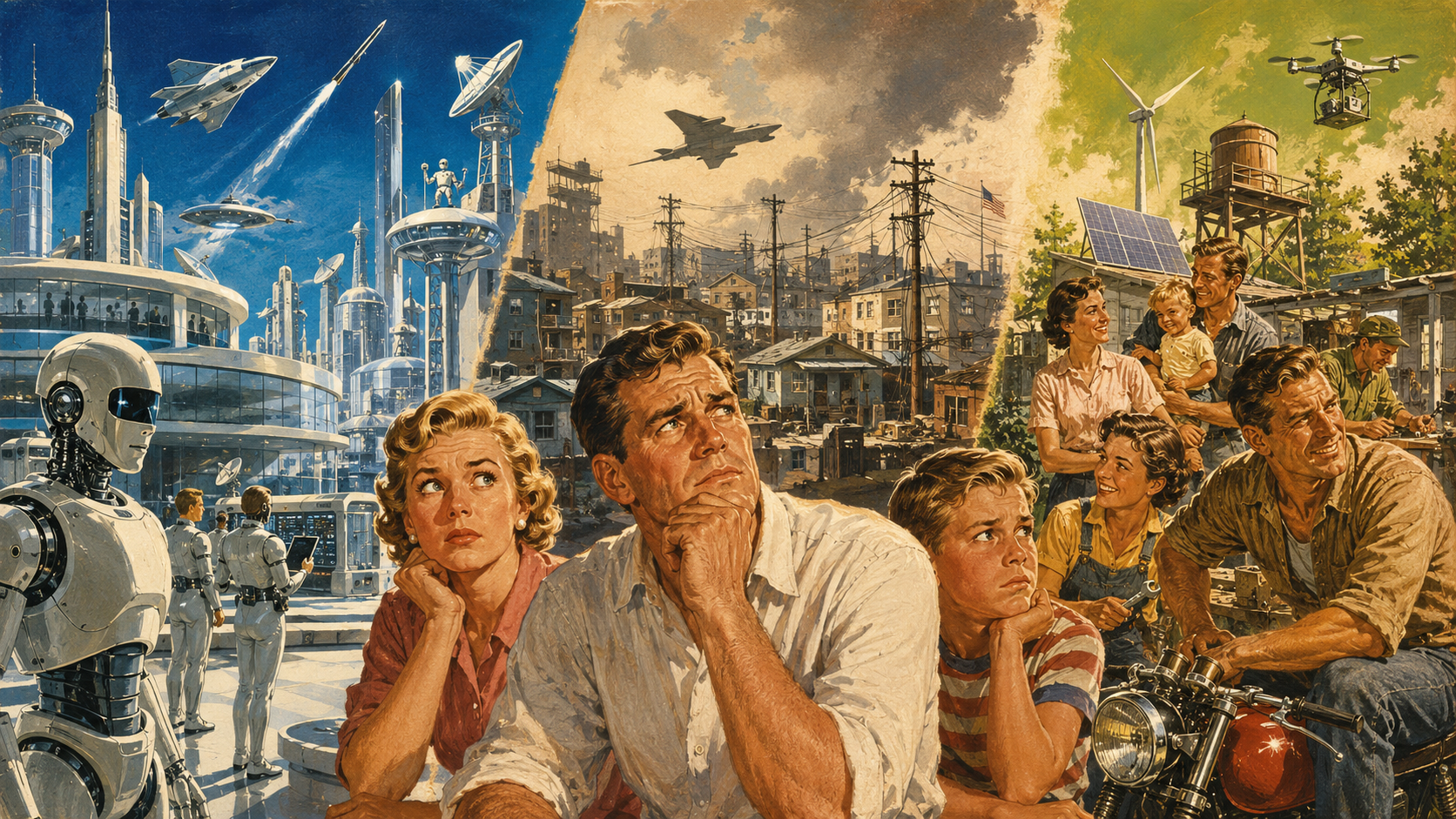
Cheap AI, solar power, drones, and private networks may create resilient low-state societies—while ordinary modern countries become the most vulnerable places on Earth
The most vulnerable country in 2050 may not be the poorest.
It may look perfectly normal.
It has thirty or forty million people. Apartment towers. Universities. Airports. Commercial banks. Hospitals. A national electricity grid. A professional military. Perhaps fifty expensive fighter aircraft and a few hundred armored vehicles.
Its citizens expect electricity around the clock, modern healthcare, pensions, safe cities, functioning infrastructure, and very few military casualties.
But the country imports its advanced semiconductors.
It rents much of its cloud infrastructure.
Its most capable AI systems come from foreign companies.
Its satellites are limited or foreign.
Its military software depends on somebody else’s technological ecosystem.
Its economy produces little at the global technological frontier.
It has accumulated nearly all the fixed costs of modern civilization without acquiring the rents generated by owning its most important technologies.
This may become an increasingly dangerous place to be.
For most of the twentieth century, we imagined economic development as a ladder:
village
→ infrastructure
→ industrialization
→ middle-income nation-state
→ advanced economy.
Technological progress may be turning that ladder into something closer to a barbell.
At the top, a small number of enormously capital-intensive technological systems could become richer, more integrated, more automated, and more capable of securing themselves than any societies in history.
At the other end, cheap technology could allow surprisingly small communities to provide much of ordinary civilization for themselves without reproducing the enormous centralized institutions that rich countries built during the twentieth century.
Between them sits the conventional modern state.
Too expensive to become primitive.
Too technologically dependent to become sovereign.
Too centralized to disappear.
And increasingly easy to see, disrupt, tax, coerce, or raid.
Fifty years of shrinking minimum scale
Something important happened during the last half-century that we rarely describe as one phenomenon.
The minimum efficient scale of technological capability collapsed.
Think about what an individual or small organization gained access to between 1975 and today.
Computation:
mainframe
→ personal computer
→ smartphone.
Communications:
national telephone company
→ internet
→ encrypted global communications.
Software:
giant proprietary systems
→ PCs
→ open source
→ cloud services.
Media:
television station
→ website
→ smartphone camera and global distribution.
Navigation:
military or professional surveying infrastructure
→ GPS in every phone.
Manufacturing:
industrial control systems
→ inexpensive sensors, microcontrollers, CNC machines, 3D printers.
Mechanical power:
large industrial machinery
→ cheap electric motors, battery tools, electric vehicles, drones.
Finance:
physical banking infrastructure
→ internet banking
→ mobile money
→ cryptocurrency and stablecoin networks.
Energy may now be going through the same transition.
For most of the industrial era, useful electricity implied an enormous centralized system:
generator
→ transmission network
→ substations
→ distribution grid
→ household.
Solar panels and batteries create a fundamentally different topology.
A household, farm, workshop, clinic, or village can increasingly produce meaningful electricity locally.
The World Bank estimates that off-grid solar could be the least-cost way to provide electricity to roughly 41% of the people who would otherwise remain without access by 2030. Off-grid systems already provided a majority of new electricity connections in sub-Saharan Africa during 2020–22.
The important point isn't that solar is environmentally friendly.
It is that electricity generation is becoming divisible.
That is politically consequential.
Silicon Valley was an early beneficiary
Much of what we call the internet startup revolution was really an economic consequence of declining minimum efficient scale.
A software entrepreneur in 1980 needed substantial capital merely to obtain computing resources.
A software entrepreneur in 2005 could buy a laptop.
By 2015, a tiny company could rent enormous computing infrastructure from Amazon or Google by the hour.
Software itself had almost zero marginal reproduction cost.
A handful of programmers could therefore create products serving millions of people.
This generated an explosion of bottom-up economic experimentation:
startups
independent developers
online commerce
freelance knowledge workers
small media companies
global software businesses.
But Silicon Valley was never actually independent of centralized civilization.
It sat on top of:
semiconductor fabs
universities
national research funding
venture capital markets
reliable electricity
property law
global finance
telecommunications infrastructure.
Centralized technological systems produced cheap tools that decentralized economic agency.
That relationship may now be entering a much more extreme phase.
The frontier is reconcentrating
While the outputs of technology become increasingly distributable, producing the frontier itself is becoming extraordinarily capital intensive.
Advanced semiconductor fabrication requires facilities costing tens of billions of dollars.
Frontier AI requires vast quantities of:
advanced chips
electricity
networking
data centers
specialized engineers
capital.
Satellite constellations require enormous launch, manufacturing, software, and ground infrastructure.
Advanced robotics increasingly depends on an entire ecosystem of:
models
sensors
precision manufacturing
batteries
semiconductors
industrial software.
The technological frontier is therefore moving upward in scale.
AI provides an unusually clean demonstration of both processes occurring simultaneously.
Stanford’s AI Index found that the cost of using AI at roughly GPT-3.5-level benchmark performance fell from about $20 per million tokens in late 2022 to $0.07 by late 2024—a decline of more than 280-fold in roughly eighteen months. Meanwhile, frontier training compute and energy requirements continued rising rapidly.
That is almost the entire thesis in miniature:
creating frontier intelligence becomes more centralized
while
using yesterday’s intelligence becomes radically cheaper.
The same pattern exists with solar panels.
Building the world's dominant photovoltaic manufacturing ecosystem requires gigantic industrial scale.
Using the resulting panel requires a roof.
The same pattern increasingly applies to chips:
creating the semiconductor requires an industrial civilization.
Using it may require a $200 device.
So technological concentration at the top does not imply technological helplessness at the bottom.
The opposite may happen.
The top becomes more powerful precisely by manufacturing increasingly capable tools cheaply enough for the bottom to use.
Civilization may have a much smaller minimum viable population
This leads to a strange question.
How many humans are actually required to sustain a reasonably advanced material life?
Not to manufacture everything.
To live well while remaining resilient.
Perhaps the interesting unit isn't a country of forty million.
Perhaps it is a community of ten thousand.
Imagine ten thousand people living in a town surrounded by productive farmland in 2050.
They do not attempt autarky.
They don't fabricate their own semiconductors or manufacture aircraft.
Instead, they localize things that are bulky, essential, or repeatedly consumed while importing things that are technologically complex but physically small.
That distinction matters enormously.
Energy
The community has:
rooftop solar
a larger community solar field
batteries
a local microgrid
perhaps hydro, wind, biomass, or some dispatchable backup.
Its critical facilities can operate even when the wider national grid fails.
Homes have electricity.
Workshops function.
Water pumps operate.
Food remains refrigerated.
Communications remain online.
The economic implication is much larger than merely lower electricity bills.
The community has eliminated one of the great dependencies of twentieth-century civilization:
the requirement that a distant national institution continuously operate an enormous synchronous machine for local life to function.
Food
Surrounding farmland provides much of the community's food.
But this is not subsistence agriculture.
Agriculture becomes increasingly mechanized and eventually partially autonomous:
electric tractors
automated irrigation
agricultural drones
machine-vision weed control
robotic equipment
AI agronomy
cold storage
local food processing.
A small percentage of the population can therefore feed everyone else.
The community still imports:
fertilizer inputs
replacement equipment
specialized seeds
electronics
machine components.
But interruption of international trade does not immediately mean starvation.
That distinction—between trade for optimization and trade for survival—may become strategically important.
Water
Water infrastructure can also become surprisingly local:
wells
reservoirs
filtration
rainwater collection
solar pumping
wastewater treatment.
This will vary radically by geography.
Ten thousand people in an arid desert face a completely different problem from ten thousand people beside abundant freshwater.
But again, the relevant technologies are becoming increasingly modular.
Housing and construction
This is where 3D printing fits—but probably in a less science-fictional way than “press a button and print a city.”
Current 3D concrete printing can automate meaningful portions of construction, and modular prefabricated printed structures are already being demonstrated. But the technology still relies heavily on conventional reinforcement, foundations, plumbing, electrical work, roofs, windows, finishing, and human quality control. Standards remain a major obstacle to widespread structural deployment.
The larger shift is therefore local digital fabrication:
automated concrete placement
prefabricated modules
CNC cutting
standardized components
AI-assisted design
local timber or earth construction
3D-printed fixtures and replacement parts
robotic excavation and material handling.
A community doesn't need to manufacture every construction material.
It needs enough local equipment and knowledge to convert:
concrete
wood
steel
glass
insulation
into buildings cheaply and repeatedly.
AI could make that easier by turning architectural, structural, electrical, and maintenance knowledge into widely available software assistance.
Construction remains physical.
But less specialized human knowledge may need to be permanently resident in the community.
Education
This is where AI could change geography much more profoundly.
Historically, advanced education generates enormous economies of scale.
A town of ten thousand cannot employ:
physics professor
Korean-language teacher
calculus specialist
programming instructor
mechanical engineer
historian
statistics professor
specialist tutor
for every conceivable subject.
A city of ten million can.
That is one reason knowledge economies concentrate geographically.
But suppose every student has a competent personalized AI tutor.
Then the school's scarce human resources shift toward:
childcare
motivation
supervision
physical education
group projects
socialization
mentoring.
The information layer becomes globally available.
The community may still need excellent teachers.
It no longer needs every possible specialist physically present.
That potentially lowers the minimum population required to offer sophisticated education by orders of magnitude.
Healthcare
Healthcare provides the harder version of the same argument.
A town of ten thousand will not support:
neurosurgery
transplant medicine
pediatric oncology
every surgical specialty.
But most healthcare isn't neurosurgery.
A local health system could plausibly combine:
physicians
nurses
laboratory technicians
pharmacists
AI-assisted diagnostics
imaging
ultrasound
remote consultation
automated medical records
emergency stabilization.
Rare conditions move outward to regional centers.
Routine medicine stays local.
That is already how many small communities work.
AI increases the range of expertise available to the people who remain physically present.
Again, the technology does not replace the human institution.
It raises the amount of civilization each skilled human can support.
Local production and repair
A resilient community would probably care much more about repair than modern consumer societies do.
Its industrial layer might include:
machine shop
welding
electronics repair
woodworking
CNC equipment
additive manufacturing
battery repair
vehicle maintenance
agricultural machinery repair.
This does not create an independent industrial economy.
It creates graceful degradation.
When an imported machine fails, the community has a meaningful probability of repairing or adapting it instead of becoming immediately dependent on the original manufacturer.
Local AI makes the repair shop more capable because technical documentation, diagnostics, programming help, and engineering assistance become cheap.
A capable mechanic with AI potentially substitutes for several narrower specialists.
Transportation
Inside the community:
electric motorcycles
bicycles
small EVs
agricultural vehicles
autonomous delivery systems
may be enough.
Between communities, one serious physical connection remains useful:
road
railway
river
coast.
And possibly a small airstrip.
I would not assume battery-electric aviation solves everything. Aircraft punish battery weight severely, and present electric-aviation research still concentrates heavily on short-range applications.
But the argument doesn't depend on batteries.
Whatever wins—
hybrid aircraft
synthetic fuel
hydrogen
electric short-haul aviation
conventional turboprops—
a small airstrip connects ten thousand people to the global high-complexity economy.
Aircraft are excellent for:
people
medicine
electronics
urgent machine parts.
They are terrible for:
cement
grain
fertilizer
steel.
So resilient communities still want one cheap bulk transport connection.
They just don't require a gigantic national transportation bureaucracy.
Finance becomes thinner too
A sophisticated local economy doesn't necessarily require a national branch-banking architecture.
Money could exist in multiple forms:
cash
conventional digital banking
mobile money
stablecoins
remittance networks
informal credit.
Bitcoin matters historically because it demonstrated that scarce digital assets can exist outside national monetary administration.
But stablecoins may be more consequential for ordinary communities.
A worker abroad can earn in a high-productivity economy and transfer purchasing power directly to a household thousands of kilometers away.
The household then buys:
solar equipment
machinery
smartphones
medicines
electronics.
A poor country's national financial system becomes less important as an intermediary between:
global productive economy
and
local household.
That is potentially a profound shift in development economics.
What actually needs to be imported?
Once you think this way, the list becomes surprisingly short.
A technologically capable ten-thousand-person community might locally provide most of its:
food
water
electricity
housing
basic construction
schooling
primary healthcare
transportation
childcare
elder care
ordinary security
repair
entertainment
local administration.
The imported layer is disproportionately composed of highly complex products:
semiconductors
computers
advanced batteries
pharmaceuticals
specialist machinery
medical equipment
precision bearings
some chemicals
vehicles
telecommunications equipment.
These represent enormous technological complexity but surprisingly little physical volume.
The community doesn't need a semiconductor fab.
It needs a shipment of chips.
It doesn't need an automobile industry.
It needs replacement vehicles every several years.
It doesn't need a pharmaceutical industry.
It needs reliable access to medicines.
The community therefore remains deeply connected to global civilization without reproducing global civilization locally.
That is not autarky.
It is low-fixed-cost civilization.
Premodern social scale, modern technological capability
Ten thousand is also interesting for another reason.
It is large enough for substantial specialization:
farmers
doctors
nurses
mechanics
electricians
builders
teachers
programmers
security personnel
shopkeepers
administrators.
But small enough that much of economic and social life can still operate through:
reputation
family
repeated interaction
religious institutions
local associations
community norms.
Modern industrial civilization replaced much of this with enormous anonymous institutions.
That trade made sense because technological sophistication required scale.
But what happens when sophisticated technology becomes usable at much smaller scales?
You could get something historically strange:
premodern social density + modern material capability.
The community does not have to recreate Sweden.
It doesn't need several layers of national bureaucracies simply to deliver electricity, knowledge, banking, media, and basic expertise.
The technological frontier increasingly arrives as products.
This is not necessarily a libertarian paradise
A thick local society has costs.
It may be:
religious
conformist
patriarchal
nepotistic
intolerant of unusual behavior
dominated by several powerful families.
There may be far less anonymity than in New York.
If your marriage collapses, everyone may know.
If your business reputation collapses, there may be nowhere else locally to go.
A strong community can protect individuals from state failure while simultaneously exerting intense social control.
So the argument is not:
decentralized society = freedom.
It is:
decentralized society can be robust.
Those are different things.
Why the bottom could become surprisingly stable
A coherent local society might actually avoid several pathologies of weak middle-income states.
Consider the struggle to control a conventional capital.
The national government controls:
electricity
television
banks
civil-service jobs
large infrastructure budgets
military procurement
international aid.
Winning national political power therefore offers enormous rents.
That encourages:
coups
patronage politics
ethnic winner-take-all competition
central corruption.
But imagine electricity is mostly local.
Economic support comes substantially from family businesses and diaspora networks.
Information travels through decentralized communications.
Education increasingly comes from global digital resources.
Local security is primarily local.
Now capturing the national capital gives you less.
Political competition can potentially become less existential.
There is less reason to fight over control of the national broadcaster if nobody needs it.
Less reason to capture the energy ministry if villages largely generate their own electricity.
Less reason to control every government job if the government isn't the dominant employer.
The state can become thin precisely because society has become thick.
That does not guarantee peace.
But it changes the economics of political control.
Violence changes rather than disappears
A distributed society may be difficult to conquer but it is not necessarily peaceful in the liberal Western sense.
Violence could become more localized:
family disputes
clan conflict
territorial feuds
contested trade corridors
protection payments
occasional raids
competition between networks.
The key distinction is that the violence may no longer require destroying the entire society.
The community's:
energy
food
housing
communications
productive life
do not depend on capturing one distant capital.
Peace can therefore be strong inside trusted communities while relations between communities become rougher.
That resembles much of premodern political history.
But with drones and smartphones.
The return of the raid
A low-fixed-cost society does not generate enormous technological rents.
It therefore has a different relationship with the wealthy external world.
Historically, frontier societies frequently interacted with richer settled societies through combinations of:
trade
migration
mercenary work
tribute
protection
raiding.
Modern raiding would not usually mean stealing machinery from a semiconductor fab.
A semiconductor fab is nearly useless without its engineers, chemicals, electricity, maintenance systems, and global suppliers.
The valuable target increasingly becomes the interface:
people
cargo
transit routes
resource sites
continuity of operation.
Economic extraction takes forms such as:
ransom
protection payments
tolls
extortion
resource rents.
Transnational criminal markets already demonstrate that organizations do not need one sovereign hierarchy to coordinate across countries.
Different networks can specialize in:
finance
logistics
local access
political protection
transportation.
The system behaves more like a market than an army.
The distributed political world may increasingly behave this way as well.
Humans remain important because physics remains important
This is where extremely rich technological societies and low-fixed-cost societies may diverge most sharply.
The technological top will increasingly substitute machines for human risk.
Its people become expensive.
A lost worker represents:
years of education
high lifetime earnings
political liability
insurance costs
pension commitments
enormous family investment.
A wealthy society will spend increasingly large amounts to prevent human exposure.
Robots inspect infrastructure.
Autonomous vehicles patrol.
Machines perform dangerous industrial work.
Military forces increasingly push sensors and weapons outward while humans remain farther away.
But robotics has a physical problem.
Software travels at approximately zero marginal cost.
Robots do not.
Robots have:
mass
batteries
moving parts
maintenance requirements
weather constraints
communications requirements.
They encounter:
mud
rocks
water
dust
trees
stairs
unpredictable humans.
Robotic logistics research still treats reliability, networking, contested environments, and physical integration as major constraints.
So even an extraordinarily advanced society may become capable of seeing much of the world without becoming capable of economically policing all of it.
Global eyes, local hands
This could define the high-tech political order.
Satellites watch huge areas.
AI continuously searches imagery.
Financial networks identify transactions.
Telecommunications reveal relationships.
Cyber systems operate globally.
Information becomes cheap to move.
Physical control remains expensive.
So the advanced technological civilization may eventually conclude:
We can see that territory.
We know roughly who controls it.
We know who trades with them.
We do not intend to govern it.
Its security policy turns inward.
Protect:
borders
ports
major cities
financial systems
citizens
strategic supply chains.
Make participation in domestic economic life increasingly authenticated.
Employment connects to verified identity.
Banking connects to identity.
Property ownership connects to identity.
Critical infrastructure connects to trusted hardware and software.
Robotics provides physical enforcement where the economics justify it.
The successful high-tech state becomes something like a fortress civilization.
Not necessarily authoritarian.
But highly legible.
The cost of living anonymously inside it rises dramatically.
The middle owns the targets
Now return to the perfectly normal country we started with.
It cannot operate like the local community.
Its population has been urbanized and socially atomized.
Millions depend on:
national electricity
commercial banking
centralized healthcare
formal employment
imported food systems
complex transportation.
Extended family structures may have weakened.
Local communities no longer provide most welfare or security.
People expect the state to work.
But the state cannot operate like the technological fortress either.
It doesn't own:
frontier AI
advanced semiconductor manufacturing
major satellite networks
globally competitive cloud infrastructure
robotic industrial ecosystems
advanced intelligence networks.
It imports them.
So it has inherited the cost structure of the top without acquiring the top's rents.
And it has abandoned much of the social resilience of the bottom.
This is the middle trap.
The middle receives invoices
The technological top earns rents from:
chips
models
cloud
finance
satellites
robotics
intellectual property.
The distributed bottom consumes their older outputs cheaply.
The middle purchases frontier capability at retail while maintaining an expensive twentieth-century society.
It needs:
universities
hospitals
pensions
bureaucracy
professional military
national grids
highways
banks
expensive cities.
It must also purchase:
chips
AI
cloud
weapons
industrial machinery
capital.
The top receives monopoly or oligopoly rents.
The bottom receives technological spillovers.
The middle receives invoices.
And then it has to defend everything those invoices paid for.
Russia and Ukraine show pieces of the problem
Russia and Ukraine are not pure examples of this future.
Russia has nuclear weapons, missiles, space capabilities, a substantial industrial base, and a serious military technology sector.
Ukraine has a highly innovative technology ecosystem supported by a functioning state and an enormous Western technological backend.
But their war illustrates an important feature of the middle-state problem.
They must defend:
cities
power generation
railways
factories
bridges
apartment buildings
telecommunications
recognizable territorial government.
Cheap precision systems make these assets increasingly targetable.
But neither society can simply abandon them.
The result is enormously expensive warfare in which technological adaptation can dramatically improve lethality without necessarily producing cheap political control.
Ukraine's direct physical reconstruction needs are already measured in hundreds of billions of dollars. The cost lies disproportionately in exactly the things a complex territorial state cannot simply abandon: housing, transport, energy, and other fixed infrastructure.
A decentralized community can lose a drone workshop and rebuild another.
A modern state cannot casually lose a power station serving two million people.
We have been here before
The industrial revolution created a surprisingly similar technological barbell.
At the top it created:
battleships
industrial artillery
railways
telegraphs
huge arsenals
modern state taxation.
The great powers weren't powerful merely because they owned guns.
They possessed entire industrial systems capable of:
producing weapons
moving armies
financing wars
replacing losses.
Some states tried to buy the outputs without reproducing the system.
Qing China purchased modern ships and weapons and built arsenals, but modernization remained institutionally fragmented.
The Ottoman Empire built substantial modern military capabilities but increasingly depended on European finance to fund them.
Several Latin American countries purchased world-class European warships despite lacking anything resembling Britain's underlying naval-industrial ecosystem.
Brazil could buy a dreadnought.
It could not buy the civilization that continuously produced dreadnought power.
That was one side of industrialization.
The other side was equally important.
Factories also produced enormous quantities of increasingly cheap:
rifles
ammunition
explosives
radios
trucks.
The minimum cost of organized resistance fell.
An anti-colonial movement did not need:
a battleship fleet
an aircraft industry
a giant steel sector.
It needed enough inexpensive technology and human organization to make foreign rule expensive.
The stronger side needed the capacity to impose continuous control.
The weaker side only needed enough capability to prevent control from becoming cheap.
That asymmetry helped transform twentieth-century politics.
AI and distributed energy may be creating the next version.
Development may no longer be a ladder
The twentieth-century development model assumed poor societies would gradually reproduce the infrastructure of wealthy ones.
Build the grid.
Build the university.
Build the banks.
Build the bureaucracy.
Build the highways.
Build the industrial base.
Urbanize.
Construct a large middle class.
Eventually become rich.
That pathway may no longer be the only technologically viable one.
A community could potentially move from:
weak state + low material capability
to:
weak state + surprisingly high local capability
without passing through every intermediate institution.
We've already seen narrow forms of this.
Some countries largely skipped universal landline networks and went directly to mobile phones.
Some communities may skip universal grid electricity and go toward distributed solar.
Finance can partially leapfrog bank branches.
AI may allow expertise to leapfrog large professional institutions.
Automated fabrication may allow portions of construction and manufacturing to leapfrog highly specialized labor systems.
These are not complete replacements.
But they don't need to be.
Each one removes another reason why ten thousand people require a state designed for forty million.
The changing minimum efficient scale of civilization
That may ultimately be the most important technological story here.
Industrial modernity increased the minimum efficient scale of sophisticated civilization.
You needed:
factories
grids
universities
bureaucracies
national transportation
large capital markets.
That favored enormous integrated states.
The technologies of the last fifty years have quietly begun reversing portions of that relationship.
Cheap computing reduces the scale required for information processing.
The internet reduces the scale required for communication.
AI reduces the scale required for expertise.
Solar reduces the scale required for electricity generation.
Batteries reduce the scale required for energy reliability.
Drones reduce the scale required for aerial capability.
Digital fabrication reduces the scale required for some manufacturing and construction.
Cryptographic networks reduce the scale required for trusted digital coordination.
None of these eliminates civilization's industrial core.
In fact, the industrial core becomes more concentrated than ever.
But fewer people need to live inside that core's organizational structure to consume what it produces.
That creates the strange possibility of two simultaneously successful worlds.
The fortress and the village
At one pole:
enormous capital
advanced AI
semiconductor fabs
satellites
robotics
integrated finance
highly legible citizens
low human exposure.
The society becomes extraordinarily productive and extraordinarily expensive.
At the other:
solar panels
batteries
cheap electronics
local AI
drones
family networks
community institutions
local agriculture
repairability
low fixed costs.
The society is much poorer.
But it may be surprisingly difficult to break.
One pole maximizes integration.
The other maximizes resilience.
And neither looks much like the ordinary twentieth-century nation-state.
The real losers may be the normal countries
I would not put precise probabilities on this world.
Nor will every rich country become a fortress, every poor community become resilient, or every middle-income country fail.
There is also a genuinely terrible fourth equilibrium:
weak state
- weak community
- cheap technology.
There, drones empower gangs.
AI helps scammers.
Solar powers armed compounds.
Communications make predatory organizations more capable.
Cheap technology does not create trust.
It amplifies whatever social structure already exists.
So the bottom itself bifurcates:
distributed resilience
versus
distributed predation.
But if even a substantial minority of lower-income societies achieve the first equilibrium, the conventional development hierarchy starts looking much stranger.
The richest societies become nearly impossible to penetrate because their entire domestic environment is technologically integrated.
The resilient local societies remain much poorer, but increasingly difficult to dominate because very little depends on a single vulnerable system.
The exposed middle gets neither advantage.
It has:
valuable citizens
expensive buildings
visible infrastructure
complex welfare obligations
sophisticated consumption expectations
imported technology
weak local resilience.
It is wealthy enough to possess targets.
Not wealthy enough to make those targets safe.
The future may be U-shaped
The usual assumption is that poor societies want to become middle-income societies and middle-income societies want to become rich.
Economically, that will remain true.
Politically and strategically, something more complicated may happen.
The stable equilibria could increasingly sit at opposite ends.
At the technological top:
enormous fixed investment
enormous upstream rents
machine coordination
domestic legibility
high individual value
low tolerance for physical risk.
At the resilient bottom:
low fixed costs
imported commodity technology
local energy
local food
human relationships
informal welfare
cheap machines
redundant institutions.
Between them:
centralized infrastructure
imported intelligence
expensive human capital
weak communities
high expectations
limited technological sovereignty.
The technological top owns the frontier.
The resilient bottom buys its discarded miracles cheaply.
The middle tries to reproduce the appearance of the top without owning the economics underneath it.
That may be the least sustainable position of all.
For fifty years, technology has lowered the minimum scale at which people can become productive.
The next fifty may lower the minimum scale at which people can sustain something approaching civilization.
If that happens, the nation-state will face pressure from both directions.
At the top, technological systems become larger than most countries can afford to reproduce.
At the bottom, communities become capable of doing more without their countries.
And the central political question of the twenty-first century may become unexpectedly simple:
How much state do ten thousand technologically equipped people actually need?