
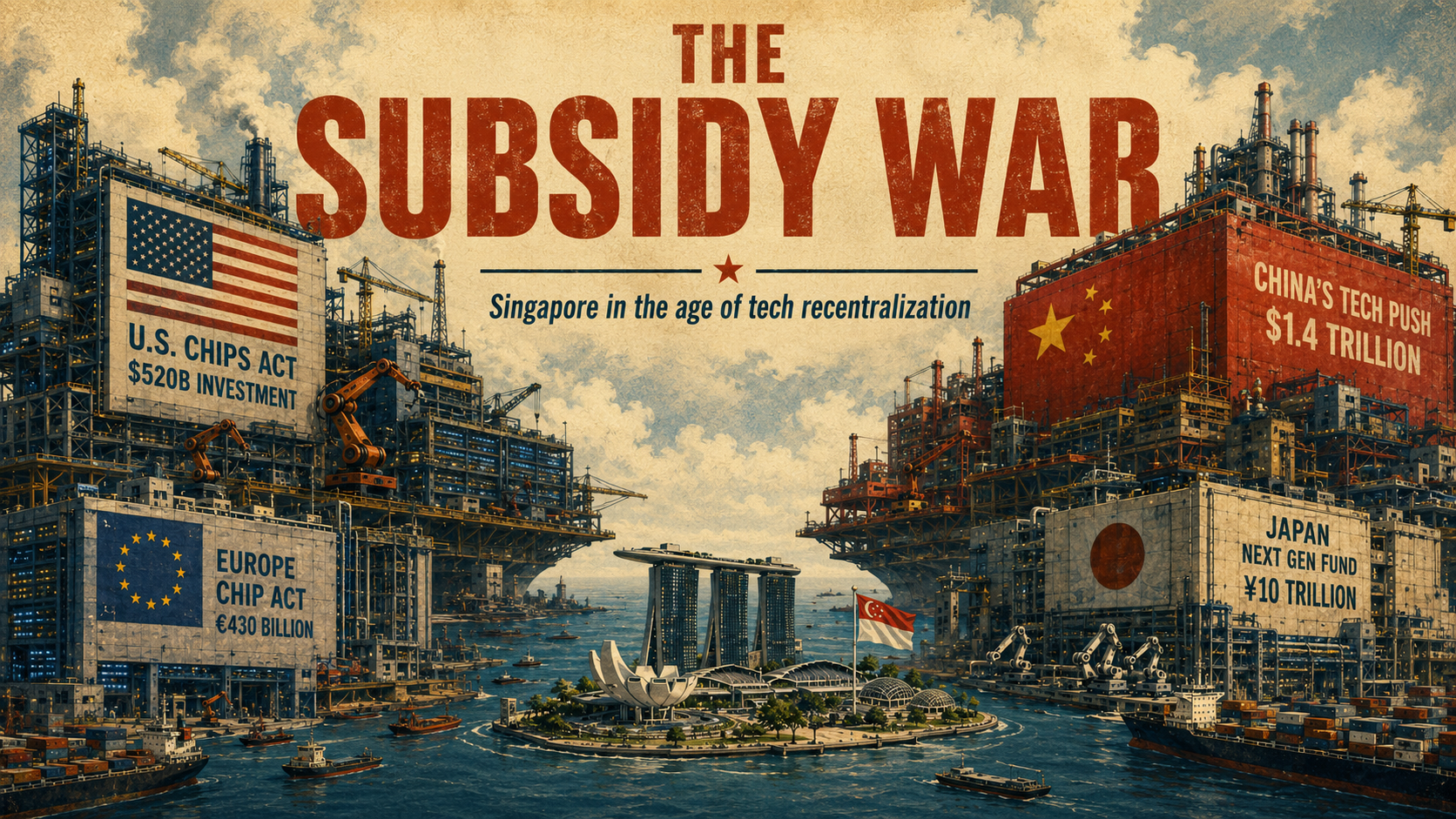
For most of the last fifty years, Singapore looked like the country that had solved economic development.
It did not have America's domestic market.
It did not have China's population.
It did not have Japan's industrial depth.
It had almost no natural resources and very little land.
So Singapore competed on something else:
Make it unusually attractive for global capital to operate here.
Keep taxes low.
Make regulation predictable.
Protect contracts and intellectual property.
Build excellent infrastructure.
Import talent.
Make visas work.
Create special incentives when necessary.
Then allow multinational companies to plug themselves into the system.
The model worked extraordinarily well.
Singapore became simultaneously:
- a financial center;
- a trading hub;
- a regional-headquarters center;
- a logistics hub;
- a semiconductor producer;
- a pharmaceutical producer;
- an aerospace center.
It became perhaps the purest expression of the economic logic that dominated the world from roughly 1980 to 2030.
And that is precisely why Singapore may now be one of the most interesting countries to watch.
Because the rules of competition may be changing underneath it.
Singapore perfected the era of the tax break.
The world may now be entering the era of the subsidy.
And I don't think this is merely a temporary burst of industrial policy caused by COVID, China or semiconductor shortages.
It may be connected to a much larger technological transition:
1980–2030: The Great Decentralization
followed by:
2030–2070: The Great Reconcentration
If that is right, Singapore's problem tells us something much larger about what the next fifty years could look like.
Singapore was optimized for a decentralizing world
Think about the technologies that dominated the last fifty years.
Again and again, technology took capability that previously belonged to large institutions and distributed it downward.
Mainframe → PC.
Broadcast media → internet creator.
Corporate office → laptop and remote worker.
Library → internet.
Bank branch → phone.
Department store → e-commerce.
Recording studio → bedroom producer.
Institutional computing → personal computing.
And now AI may complete the sequence:
Institutional procedural knowledge → personal AI agent.
This last step is more important than simply giving everyone access to information.
The internet already gave you the tax code.
It did not necessarily tell you how to comply with it.
The internet gave you immigration regulations.
It did not necessarily identify exactly which documents applied to your situation, prepare them, monitor your case, challenge a rejection and navigate the bureaucracy.
The internet gave you medical literature.
It did not turn you into a physician.
The internet gave a small business access to employment law, accounting rules, procurement requirements and corporate regulations.
It still required lawyers, accountants, consultants and administrators to actually operate inside those systems.
AI potentially attacks that final institutional advantage.
Rules + documents + precedent + your circumstances → action.
That could give one person administrative capabilities that previously required an organization.
So the deeper pattern of the digital era was:
Institution → company → small team → individual.
The minimum efficient unit kept shrinking.
And Singapore was exceptionally well suited to this world.
When businesses became increasingly footloose, Singapore didn't need to own the companies.
It simply needed to provide the best environment around them.
The winning government asked:
How can I reduce friction?
Tax.
Regulation.
Capital controls.
Permitting.
Immigration.
Legal uncertainty.
Infrastructure failure.
Reduce enough of those, and global capital arrives on its own.
This was the era of the regulatory sandbox
The characteristic policy instrument of this world was not the gigantic government factory.
It was the regulatory sandbox.
The basic promise was:
Come here. We will let you experiment.
The state did not necessarily need to build your industry.
It created the conditions under which private capital could build the industry itself.
For many kinds of digital businesses, that was enough.
A software company did not require the Singaporean government to reconstruct the country before it could operate.
It needed talent, capital, servers and legal certainty.
That is an extraordinarily lightweight development model compared with building a steel industry, national highway network or shipbuilding complex.
Singapore became extremely good at it.
But Singapore also made an unusual decision.
Unlike Hong Kong, it refused to abandon manufacturing.
Singapore deliberately maintained a large manufacturing base, concentrating on capital-intensive sectors such as semiconductors, pharmaceuticals, chemicals and aerospace.
That worked because Singapore could combine:
- excellent infrastructure;
- political stability;
- tax incentives;
- IP protection;
- global talent;
- world-class logistics.
A multinational might rationally pay somewhat higher labor and land costs because everything surrounding the factory worked.
For decades, this was a formidable package.
But now something strange is happening.
The competitors stopped merely offering better environments
Imagine a semiconductor company deciding where to put a $20 billion fabrication plant.
Singapore can say:
We have excellent courts, outstanding logistics, predictable regulation and competitive taxes.
America can increasingly say:
We will give you billions of dollars.
Japan:
We will give you billions, subsidize your R&D and organize the supplier ecosystem around you.
Korea:
We will finance the plant, help build the power and water infrastructure and support the surrounding semiconductor cluster.
China:
We will mobilize the state around the entire industry.
Singapore itself has responded by creating refundable investment incentives that can support a substantial share of qualifying investment.
That is already a move away from the older model in which the main weapon was simply a low effective corporate tax rate.
The important change is conceptual.
Old competition: Which government takes the least from the company?
New competition: Which government contributes the most to building the system?
That is a completely different game.
And large states have an obvious advantage.
People may be treating today's subsidies as temporary
The conventional explanation is straightforward.
COVID broke supply chains.
China became a geopolitical threat.
Governments panicked about semiconductors.
So America, Japan, Korea and Europe temporarily subsidized strategic industries.
Eventually things normalize.
Perhaps.
But I think there is a much more severe possibility.
Semiconductors may simply be the first visible example of the new capital economics.
Because what comes after AI is not merely more software.
It is AI entering the physical world through:
AI + robots + batteries + sensors + autonomy + advanced semiconductors + new energy systems.
And that could require rebuilding enormous portions of national capital stock.
Not upgrading them.
Rebuilding them around different assumptions.
We keep imagining AI attached to the twentieth century
Most discussions of AI infrastructure are strangely conservative.
We take the existing world and add robots.
Road + sensors.
Warehouse + robotic forklift.
Hospital + AI doctor.
School + AI tutor.
Military + drone.
But major general-purpose technologies historically did something more radical.
The automobile did not merely replace the horse.
Eventually it produced:
- highways;
- suburbs;
- parking;
- gas stations;
- shopping malls;
- motels;
- truck logistics;
- new zoning;
- new metropolitan geography.
America was physically rebuilt around the automobile.
Electricity was similar.
Factories initially replaced steam power with electric motors.
But the larger productivity gains came when factories themselves were reorganized around electricity.
The Green Revolution was not simply a better seed.
It required fertilizer, irrigation, machinery, storage, roads, finance and distribution.
The complementary infrastructure changed.
That is what a genuine technological revolution eventually means.
So the correct question about AI is not:
Where should we install robots?
It is:
What would we build if we designed the country from scratch assuming intelligence, sensing and physical machine labor were abundant?
That gives very different answers.
Imagine the hospital built from scratch
Suppose by 2050 many basic medical functions happen at home.
Skin screening.
Blood pressure.
ECG.
Routine blood tests.
Urine analysis.
Sleep monitoring.
Basic imaging.
Continuous biomarkers.
AI increasingly interprets them.
At first glance that looks like another example of decentralization:
Hospital → home.
But that may be misleading.
Because the functions left inside the hospital become the extremely capital-intensive ones.
Surgery.
Complex imaging.
Cell therapy.
Emergency medicine.
Advanced oncology.
Robotic intervention.
Imagine a future medical facility containing:
- hundreds of specialized surgical robots;
- automated pathology;
- massive imaging systems;
- genomic laboratories;
- robotic pharmacies;
- cell-manufacturing facilities;
- enormous AI compute;
- automated logistics;
- highly specialized human experts supervising machines.
Why reproduce that infrastructure every few kilometres?
If transportation also becomes autonomous and much faster, the catchment area of one medical facility expands enormously.
You might end up with:
Home diagnosis → local stabilization → giant regional intervention center.
And why put that center on extremely expensive downtown land?
Perhaps it sits fifty kilometres outside the city beside cheap land, enormous electricity supply, highway, rail, autonomous aircraft access and data-center infrastructure.
The future hospital begins to resemble:
TSMC fab + airport + medical campus.
That is not today's hospital with AI attached.
It is a different institution.
Now do the same thought experiment everywhere
The robot-native warehouse is not today's warehouse with fewer workers.
Its entire geometry changes because aisles no longer need human width.
Lighting may matter less.
Temperature can change.
Shelving changes.
Vertical space changes.
Loading changes.
Factories undergo the same transformation.
Ports become gigantic automated machines.
Mining changes.
Agriculture changes.
Construction changes.
Military bases change.
Power infrastructure changes.
Transportation changes.
Cities themselves eventually change.
If autonomous vehicles don't need the same parking, road geometry, fueling infrastructure or safety margins as human drivers, then simply installing sensors on existing roads misses the point.
The road system itself may eventually be redesigned.
And once that happens across enough industries, we are no longer discussing technological adoption.
We are discussing:
National recapitalization.
This may be a fundamentally centralizing technological era
This is where the last fifty years become a dangerous guide to the next fifty.
The digital revolution repeatedly lowered the amount of fixed capital required to possess capability.
A television network once required enormous capital.
YouTube allowed one person to distribute video globally.
A recording studio once required enormous capital.
Software allowed a teenager to produce music in a bedroom.
Computing once required institutional hardware.
The PC pushed it onto an individual's desk.
The pattern was simple:
Fixed cost ↓
But advanced physical systems can move in the opposite direction.
The best facility may require much larger fixed investment.
At the same time, automation reduces the marginal cost of operating it.
Autonomous logistics reduce the cost of distance.
Put those together:
Fixed cost ↑
Marginal operating cost ↓
Cost of distance ↓
And the economic pressure is obvious:
Optimal scale ↑
Huge fixed costs.
Tiny marginal costs.
Large service radius.
That is almost the perfect recipe for concentration.
Humans were one reason physical capital had to be distributed
This is another implication we rarely discuss.
Factories require workers.
Workers require houses.
Workers require reasonable commutes.
Hospitals require thousands of employees.
Warehouses require labor pools.
Ports require dockworkers.
Mines need entire settlements.
Human labor forced some degree of geographical dispersion.
Machines don't necessarily care where they live.
A gigantic robotic factory can theoretically sit eighty kilometres from a city beside a power plant, rail terminal, water supply and cheap land.
The human managers can be few.
Some can operate remotely.
So eliminating humans from production can paradoxically make production more geographically concentrated.
Likewise, autonomous transportation reduces one of the primary penalties of centralization:
Distance.
This could produce larger warehouses.
Larger ports.
Larger hospitals.
Larger industrial campuses.
Larger energy complexes.
Larger research centers.
Perhaps even larger metropolitan concentrations.
The cloud may have shown us the pattern already
The digital revolution supposedly decentralized computing.
And from the user's perspective, it did.
Everyone has a smartphone.
Everyone has a computer.
Everyone can access enormous computational capability.
But look underneath.
The backend increasingly became:
Hyperscale data center.
The interface decentralized.
The physical infrastructure recentralized.
AI pushes this further.
Millions of people have personalized AI interfaces.
Behind them sit enormously expensive concentrated systems involving GPU clusters, power infrastructure, cooling, fiber and semiconductor fabs.
That architecture may now spread beyond computing.
The home health monitor becomes the terminal.
The giant robotic medical complex becomes the data center.
The delivery robot becomes the terminal.
The enormous autonomous logistics campus becomes the data center.
The AI tutor becomes the terminal.
The giant research institution with advanced laboratories and compute becomes the data center.
The user experiences decentralization.
Capital experiences concentration.
And in the next technological regime, it may be the capital side that matters more.
Now return to Singapore
This creates an uncomfortable problem.
Singapore built perhaps the world's most sophisticated strategy for attracting internationally mobile capital.
But what if capital becomes less internationally mobile unless governments move with it?
Suppose the next semiconductor complex requires:
- $20 billion of factory investment;
- $5 billion of energy infrastructure;
- $3 billion of supplier ecosystem;
- $2 billion of training and R&D.
The question is no longer:
Which country gives the company the nicest regulatory environment?
It is:
Which state can coordinate a $30 billion system?
Singapore can certainly subsidize selected projects.
It has immense institutional competence and unusually strong fiscal capacity for a small country.
But it cannot rationally compete with the United States, China, Japan, Korea and Europe across every strategic sector.
So it must choose.
Perhaps Singapore remains dominant in:
- selected semiconductor niches;
- biologics;
- aerospace;
- financial services;
- regional headquarters;
- logistics.
But the cost of maintaining its famous finance + manufacturing combination rises.
In the old world, that diversification was supported by exceptional regulation, tax advantages and infrastructure.
In the new world, it may increasingly require writing very large cheques.
Hong Kong suddenly looks different
This also makes Hong Kong's extreme specialization more interesting.
Hong Kong allowed almost all physical manufacturing to migrate into the Pearl River Delta decades ago.
Conventional analysis treats that as vulnerability:
Singapore kept manufacturing. Hong Kong became dangerously dependent on finance.
But perhaps Hong Kong made a different bet.
It effectively said:
China will own the gigantic physical capital stock. We will try to own the financial layer above it.
Hong Kong doesn't need to place the factory inside Hong Kong.
Shenzhen, Dongguan and the wider Greater Bay Area can contain the physical production.
Hong Kong can concentrate on capital, wealth management, financial intermediation, RMB flows and asset markets.
That may prove risky.
But it avoids one particular problem Singapore now faces:
Having to continuously bid against giant sovereigns for industrial capital.
Singapore purchased diversification insurance.
The premium on that insurance may now be rising.
The tax haven may be an institution of the old technological regime
This is the broader point.
The globalization era rewarded small states capable of creating exceptional rules.
Ireland did not need to outspend America.
Singapore did not need China's domestic market.
Hong Kong did not need its own industrial hinterland.
The competitive advantage was:
Competence + tax + regulation + openness.
That allowed tiny jurisdictions to intermediate economic activity vastly larger than themselves.
But if the central economic problem becomes:
Build $50 billion of new physical infrastructure before somebody else does,
scale returns.
A large sovereign possesses something a regulatory sandbox cannot reproduce:
A gigantic balance sheet.
And subsidies become more than corporate welfare.
They become one mechanism through which the country rebuilds itself around the next technological system.
Subsidies may therefore keep expanding
Today:
Semiconductors are strategic.
Tomorrow:
Batteries are strategic.
Then robotics.
Then autonomous transport.
Then electricity.
Then ports.
Then defense production.
Then perhaps medical infrastructure.
Each investment creates complementarities that require another investment.
A semiconductor ecosystem needs power.
Power needs grid investment.
AI compute needs chips.
Robotic factories need AI.
Autonomous logistics need roads, ports and charging infrastructure.
And once a country has invested enormous sums into the first layer, abandoning the next layer can destroy the value of what it already built.
Subsidy → capital stock → complementary capital → next subsidy.
At the same time:
U.S. subsidies ↑ → Japan subsidies ↑ → Korea subsidies ↑ → China subsidies ↑
Nobody needs to like this equilibrium.
They simply have to fear losing the strategic capital stock.
The next fifty years may look less like 1980–2030 than we assume
One of the strongest biases in technology is assuming that the direction of the last technological era is the natural direction of technology itself.
For fifty years:
Technology decentralized capability.
So we assume the future means:
smaller organizations, distributed networks, remote work, individualized tools, lighter infrastructure.
But there is no law saying technology must decentralize.
The technologies of the digital era happened to attack information costs.
The technologies now emerging may attack labor, transport and coordination costs while increasing the fixed capital required to operate at the frontier.
That produces the opposite economics.
1980–2030: Minimum efficient unit shrinks.
2030–2070: Minimum efficient physical system expands.
This does not mean individuals become powerless.
Quite the opposite.
AI may make an individual extraordinarily capable.
But behind that individual could sit increasingly enormous physical systems.
Personal intelligence. Concentrated capital.
Singapore may tell us when the regime has changed
That is why I would watch Singapore.
Singapore is not declining.
It may remain one of the richest and most competent societies on Earth.
That isn't the interesting question.
The interesting question is what Singapore has to do to remain Singapore.
If ten years from now it can still win frontier industries primarily through better regulation, better infrastructure, better talent and reasonable taxes, then perhaps the globalization-era model remains alive.
But if maintaining the same position increasingly requires:
- billions in subsidies;
- state financing;
- energy guarantees;
- government-built infrastructure;
- industrial coordination;
then something deeper has changed.
The country that perfected the regulatory sandbox will have been forced to become a subsidy state.
And Singapore won't be unusual.
It will simply be early enough, small enough and competent enough that the transition is easy to see.
The defining question of the old era was:
How little friction can the state impose on capital?
The defining question of the next may be:
How much capital can the state mobilize to rebuild the physical economy?
That is a profound reversal.
And if the next technological regime really does require countries to reconstruct hospitals, ports, factories, energy systems, military infrastructure, logistics and eventually cities around autonomous machines, then today's semiconductor subsidy race is not the aberration.
It is the opening scene.
Singapore built the perfect state for the age of decentralization.
The next test is whether the same state can adapt to an age of radical reconcentration.