
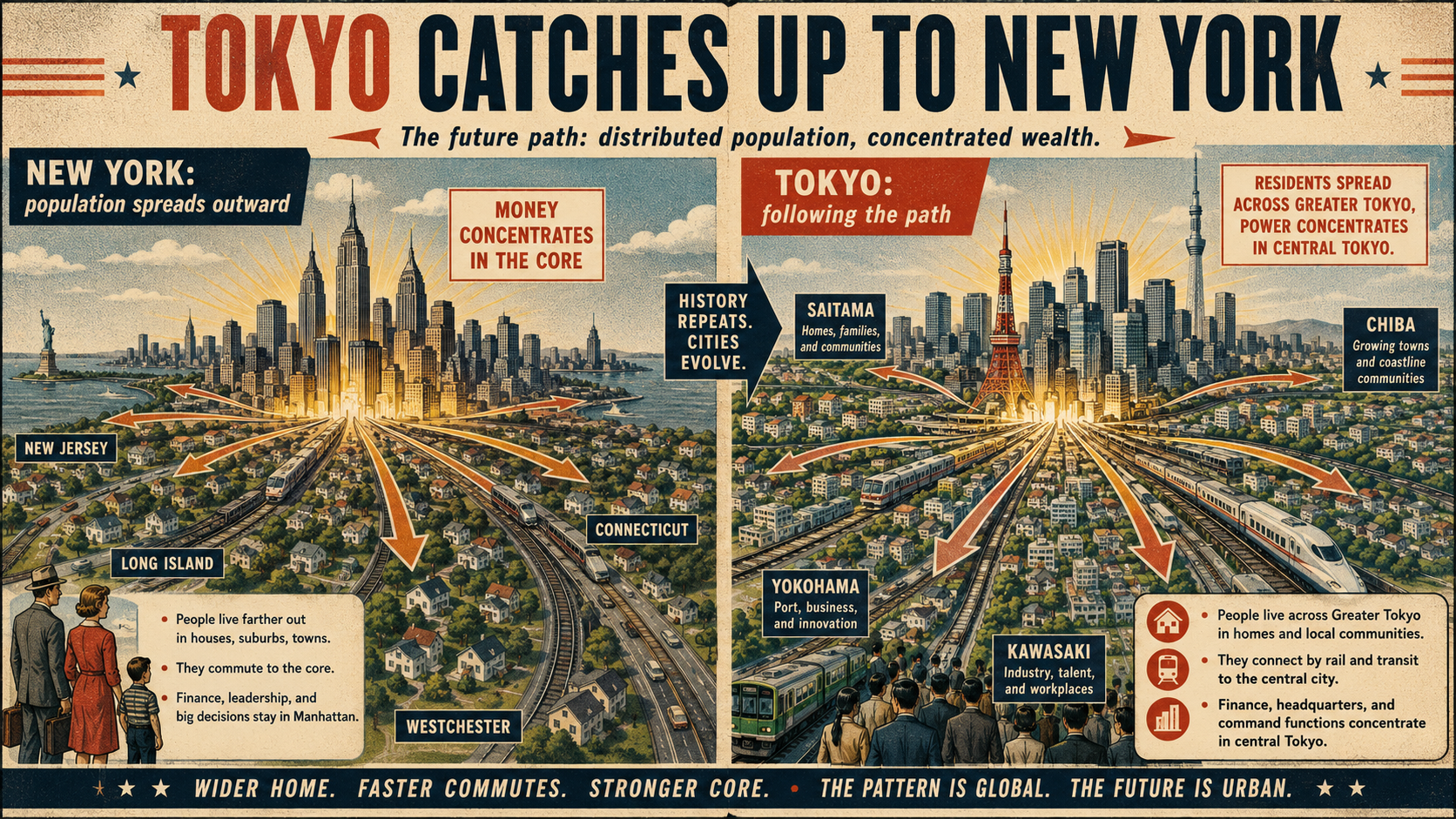
Why Tokyo could keep concentrating wealth after its population peaks—and why the housing windfall enjoyed by Western Boomers may not repeat for Millennials and Gen Z.
There is a strange assumption embedded in most discussions of Japanese demographics.
Japan is shrinking.
Therefore Tokyo will eventually shrink.
Therefore Tokyo property should become less attractive.
The first two statements may be true.
The third does not necessarily follow.
In fact, I think the opposite possibility deserves more attention:
Japan can shrink, Tokyo can stop adding population, and central Tokyo can still become economically more valuable.
The historical analogy I find useful is New York.
Not because Tokyo will become New York.
But because New York demonstrates something counterintuitive:
A metropolis can stop concentrating people while continuing to concentrate money.
That may be exactly the next stage of Tokyo's development.
And if it is, it has a very different implication from simply saying:
“Tokyo population will keep growing, so buy property.”
The interesting property may not be where people increasingly live.
It may be where the economic rents ultimately accumulate.
New York stopped concentrating people long before it stopped concentrating wealth
Manhattan's population peaked remarkably early.
By the postwar period, New York was already undergoing a massive residential decentralization.
People moved outward.
New Jersey expanded.
Long Island expanded.
Westchester expanded.
Connecticut became increasingly integrated into the New York economy.
Across the Northeast, Boston, Philadelphia, Baltimore and Washington developed large metropolitan systems of their own.
The old relationship between the economic center and residential center was breaking down.
People no longer needed to live in Manhattan to participate in the Manhattan economy.
They could live forty kilometers away and commute.
So the metropolitan system increasingly became:
distributed bedrooms + concentrated command center
And this is where something interesting happened.
Population spread outward.
But the highest-value economic functions did not spread proportionately.
Finance concentrated in New York.
Investment banking.
Asset management.
Capital markets.
Corporate law.
Advertising.
Media.
Professional services.
Corporate decision-making.
The Manhattan population no longer needed to explode for Manhattan to become extraordinarily valuable.
The relevant variable became:
economic value competing for access to Manhattan
rather than:
the number of people sleeping in Manhattan.
That distinction is extremely important.
The suburbs got the people. Manhattan increasingly got the money.
This sounds almost contradictory.
If people are moving outward, shouldn't economic activity move outward too?
Some of it did.
But high-value knowledge industries exhibit powerful agglomeration effects.
A hedge fund wants to be near investors, bankers, lawyers, other funds, executives, information and specialized workers.
An investment bank wants to be where the deals are.
A corporate law firm wants to be where the clients are.
The more valuable the ecosystem becomes, the more expensive it becomes not to participate in it.
So the process starts reinforcing itself:
finance concentration → high-income talent → specialized services → more finance concentration
Meanwhile, the worker does not necessarily need to live next door.
Railroads, highways and eventually digital communications allow the residential footprint to spread dramatically farther than the economic command structure.
New Jersey can therefore grow residentially without replacing Manhattan economically.
That is a very different kind of urban concentration.
And it is probably a better framework for thinking about Tokyo than simply asking whether the population of central Tokyo keeps rising.
Greater Tokyo is already more consolidated than the American Northeast
Usually people compare Tokyo to New York.
I think that comparison understates Tokyo.
A more useful abstraction is:
Greater Tokyo ≈ New York + Washington + Boston + Philadelphia
compressed into one enormous metropolitan economy.
The analogy is obviously imperfect.
But look at the functions.
Otemachi and Marunouchi contain finance and major corporate headquarters.
Kasumigaseki and Nagatacho contain the national government.
Shibuya contains technology and media.
Tokyo's universities, hospitals and research institutions provide some of the functions Boston performs in the United States.
Yokohama and Kawasaki add industrial and logistics depth.
Then an extraordinarily developed rail system ties the whole thing together.
America distributes national economic functions across New York, Washington, Boston, Philadelphia, Chicago, San Francisco and Los Angeles.
Japan distributes much more of them within one metropolitan system.
That makes Tokyo's future in a shrinking Japan especially interesting.
A shrinking country may become more centralized, not less
The normal intuition is:
population decline → everything gets smaller.
But relative concentration can increase while absolute population declines.
Imagine Japan falls from roughly 125 million people toward 100 million.
Now imagine Greater Tokyo falls only from 37 million to 34 million.
Tokyo has lost three million people.
Yet its share of Japan has increased substantially.
So:
Tokyo population decline does not necessarily mean Tokyo decentralization.
Japan could become smaller and more Tokyo-centric at the same time.
There is also an economic reason this could happen.
A large growing country can support many nearly complete ecosystems:
Tokyo.
Osaka.
Nagoya.
Fukuoka.
Sendai.
Regional centers.
A shrinking country has a harder time doing so.
Specialized industries need minimum scale.
Financial markets need counterparties.
Research ecosystems need talent.
Professional services need clients.
Headquarters prefer other headquarters.
There are increasing returns to density.
So demographic decline could eventually turn several partial ecosystems into one or two increasingly dominant ecosystems.
Tokyo starts with an enormous advantage.
Capital.
Government.
Universities.
Media.
International connectivity.
Headquarters.
Labor-market depth.
Prestige.
That could create a surprisingly powerful feedback loop:
best jobs → young talent → companies → specialized services → more best jobs
The country gets smaller.
The center becomes relatively stronger.
But central Tokyo does not need millions more residents
This is the part I think housing analysis often gets wrong.
If Tokyo becomes more dominant, people assume:
More people need to live in central Tokyo.
Not necessarily.
The New York model suggests something different.
The population can increasingly live across Saitama, Chiba, Kawasaki, Yokohama and outer Tokyo.
Those places provide larger homes, lower housing costs, schools, family space and ordinary services.
Meanwhile the highest-value economic functions continue concentrating in Chiyoda, Chuo, Minato and selected Shibuya or Shinjuku districts.
So the metropolitan system becomes more residentially polycentric while becoming economically more centralized.
In simple terms:
Saitama gets bedrooms. Central Tokyo gets command functions.
That is not a contradiction.
It may be the natural mature form of a giant metropolitan economy.
This is why I would not automatically buy Saitama, Chiba or Yokohama
There is an obvious investment mistake lurking here.
If more people live in Saitama, one might conclude:
Buy Saitama housing.
But population is not the same thing as economic rent.
A place can remain highly populated while housing returns stagnate.
Why?
Because housing supply may be relatively elastic.
If one neighborhood becomes expensive, move two stations farther out.
Build another tower.
Develop another site.
There are substitutes.
So I would divide metropolitan housing into two categories.
First:
Housing that accommodates metropolitan population.
Second:
Land that captures metropolitan economic rents.
The first can be extremely useful without becoming an extraordinary investment.
The second is where scarcity matters.
Manhattan's great advantage was not that everyone eventually had to live there.
They clearly did not.
Its advantage was that increasingly valuable economic activities competed for access to a fixed amount of land.
If Japan becomes more Tokyo-centric, the equivalent question is not:
Where will another million households sleep?
It is:
Where will an increasing share of Japanese economic command value accumulate?
That points much more toward central Tokyo than generic Greater Tokyo housing.
But this is not an argument to buy central Tokyo at any price
Tokyo itself provides the obvious warning.
Central Tokyo experienced an extraordinary property bubble around 1990.
Then it collapsed.
Prime land values fell enormously.
Some elite locations spent decades below their bubble-era valuations.
So:
great city + great long-term thesis does not equal a good investment at every price.
You can be correct about Tokyo in 2050 and still lose money buying Tokyo at the wrong valuation in 2026.
That is exactly why the New York comparison should not become:
Manhattan eventually became incredibly valuable, therefore buying Manhattan was always a good decision.
It wasn't.
There were long periods when Manhattan land produced terrible real returns.
Timing mattered.
Entry valuation mattered.
The structural thesis mattered.
All three have to align.
But Tokyo may still have something Western global cities increasingly lack
An unfinished structural revaluation.
That is what makes Tokyo interesting to me.
New York is already New York.
London is already London.
San Francisco already underwent the technology-driven revaluation.
Toronto already experienced decades of population growth, falling interest rates and housing financialization.
A buyer today is paying a price that already reflects much of that history.
Tokyo is different because Japan's demographic decline may create a new relative-centralization dynamic over the next thirty years.
The bet would not simply be:
Tokyo remains important.
That is obvious.
The bet is:
Tokyo captures an increasing fraction of Japanese economic value even as Japan shrinks.
If that happens, scarce central land could still undergo a meaningful relative revaluation.
Not necessarily an explosive one.
Not necessarily immediately.
But there is at least a plausible mechanism.
For many mature Western cities, I find the equivalent mechanism much harder to identify.
This is the uncomfortable part for Millennials and Gen Z
Their parents experienced one of the greatest housing wealth expansions in modern history.
Buyers benefited from several enormous forces simultaneously:
urbanization,
falling interest rates,
globalization,
financial deepening,
population growth,
restricted housing supply,
rising professional incomes.
Then mortgage leverage multiplied the result.
Someone bought $300,000 of housing.
Twenty or thirty years later it was worth $1.5 million.
It became one of the defining wealth experiences of the generation.
And naturally the lesson passed down was:
buying a house = building wealth.
The problem is that Millennials and Gen Z are often buying the same house at the $1.5 million end of the transaction.
That is not the same investment.
The seller captures the historical revaluation.
The buyer must discover a new one.
A house can double and still be a mediocre investment
Suppose a Millennial buys a $1 million home.
It appreciates at 3.5% per year.
Twenty years later:
$1 million → about $2 million
That sounds wonderful.
My house doubled.
But suppose inflation averages 2.5%.
The general price level rises by about 64%.
In today's purchasing power, the outcome is roughly:
$1 million → $1.22 million
Twenty years of ownership produced about 22% real capital appreciation.
And that is before mortgage interest, property tax, maintenance, insurance, renovations, and buying and selling costs.
The homeowner still built wealth.
But a large amount of that wealth may simply come from paying down the mortgage for thirty years.
That is forced saving.
It is not the same thing as the underlying asset producing extraordinary investment returns.
This distinction gets blurred constantly because nominal numbers become very large over thirty years.
The bubble may never pop
I increasingly think this is the most likely misunderstanding about Western housing.
Everyone asks:
When does the housing bubble crash?
Maybe it doesn't.
Maybe the generational disappointment happens another way.
Imagine:
Housing stays expensive + nominal prices continue rising + real appreciation becomes mediocre.
There is no 2008-style collapse.
No dramatic reset.
No moment when everyone admits the old housing model failed.
A $1.5 million house becomes $3 million.
Everyone feels richer.
But inflation absorbed much of the gain.
Carrying costs absorbed more.
The next generation simply receives a much lower real return than its parents did.
That is politically much easier than a 40% crash.
And financially it may be much more plausible.
Then comes the fiscal problem
The next twenty to thirty years contain another risk the previous generation did not face in the same way.
Developed countries are aging.
Retiree populations are growing.
Healthcare costs are rising.
Pension systems require funding.
Government debt is already high.
Defense spending is rising again.
The ratio of workers to beneficiaries deteriorates.
Governments eventually need some combination of higher taxes, lower benefits, later retirement, immigration and higher productivity.
And property is an unusually attractive tax base.
Why?
Because:
property cannot leave the country.
A corporation can relocate.
Capital can cross borders.
A wealthy person can emigrate.
Your apartment cannot.
The government knows where it is.
Its value is visible.
It can be reassessed.
And if it has appreciated enormously, taxing it can be presented politically as taxing accumulated wealth rather than productive work.
That creates a completely different long-horizon risk for today's homeowner.
I would not assume today's property-tax regime survives until 2050
This does not require dramatic confiscation.
The realistic mechanism is much slower.
Higher property-tax rates.
More frequent market reassessment.
Luxury-property surcharges.
Second-home taxes.
Vacancy taxes.
Higher transfer taxes.
Reduced capital-gains exemptions.
Inheritance taxation.
Municipal levies.
The state can increase its claim gradually.
Suppose today's effective recurring burden is 0.7% of property value.
Over twenty years it eventually becomes 1.4%.
That is a doubling of the real effective burden.
I would not call that an absurd scenario for 2030–2050.
Now put it beside 3.5% nominal appreciation and 2.5% inflation.
Your gross real appreciation is approximately 1%.
An additional 0.7% annual government claim consumes most of it.
Before insurance.
Before maintenance.
Before financing.
That changes the economics dramatically.
Property taxes also reduce the value of the property itself
This is easy to overlook.
Suppose future buyers know they must pay $20,000 more every year in recurring property taxes.
They will not simply absorb that cost without changing what they are willing to pay.
The future tax liability gets capitalized into the asset.
So higher property taxation can hit an owner twice:
higher annual carrying cost + lower capital value than otherwise.
This is why I think thirty-year housing models that assume the current property-tax structure remains unchanged are too optimistic.
The house is permanent.
The tax regime isn't.
Western governments may gradually harvest the housing gains of the previous generation
There is an awkward political logic here.
Older households accumulated enormous property wealth.
Younger households find housing unaffordable.
Governments face growing welfare-state costs.
Expensive urban property therefore becomes a highly attractive target.
Not necessarily through:
Take away their homes.
More likely:
let nominal property values remain high + increase the state's share of the land rent.
That equilibrium has several advantages.
Banks do not suffer a housing collapse.
Existing owners continue seeing high nominal valuations.
Governments collect more revenue.
Politicians can tell younger voters that wealthy property owners are contributing more.
You don't need to pop the bubble.
You slowly harvest it.
The previous generation experienced the Great Revaluation
The next generation may experience the Great Harvest.
That is how I would distinguish the two eras.
The twentieth-century housing winner bought before the Great Revaluation.
The city became globally important.
Land became scarce.
Interest rates fell.
Credit expanded.
Population grew.
High-value industries concentrated.
The owner captured the increase.
The Millennial or Gen-Z buyer may increasingly purchase into the Great Harvest.
The city is already globally important.
The land is already expensive.
The previous owner already captured much of the structural revaluation.
Affordability creates political constraints on further appreciation.
Governments increasingly need revenue.
So the remaining land rent gets divided among:
owner + bank + government + insurer + maintenance sector
The homeowner can still do fine.
But that is completely different from becoming wealthy simply because they happened to buy urban land before everyone realized how valuable it would become.
This is why Tokyo is the housing market I still find structurally interesting
Not because Tokyo housing cannot decline.
It can.
Not because Japanese demographics are good.
They aren't.
Not because Tokyo is obviously cheap.
It isn't.
Tokyo interests me because I can still identify a plausible structural transformation that has not necessarily finished:
Japan shrinks → economic activity consolidates → Tokyo captures a larger share → central Tokyo captures an even larger share of command functions.
Meanwhile residential population can remain distributed across the giant Greater Tokyo system.
That resembles New York's mature metropolitan evolution:
population spreads outward + money concentrates inward.
If that happens, central Tokyo land could capture something that generic Saitama or Chiba housing does not.
Not population growth.
Agglomeration rent.
That is a much stronger investment thesis.
But I would still wait for price
The conclusion is not:
Buy Tokyo immediately.
The conclusion is:
Tokyo has a structural story worth waiting to buy correctly.
There is a huge difference.
Tokyo's own 1990s history demonstrates what happens when someone buys an excellent city at an absurd valuation.
The ideal setup would be:
temporary property dislocation + permanent economic centralization
A recession.
A demographic wave.
Higher rates.
Inheritance supply.
A temporary withdrawal of foreign buyers.
Anything that pushes down central Tokyo property without changing the underlying concentration thesis.
That would be far more interesting than simply chasing prices because Tokyo appears destined to remain important.
The question I would ask before buying property anywhere
Not:
Is this a good city?
And not:
Will people still want to live here in thirty years?
Those are too easy.
I would ask:
What major economic revaluation remains for me—the next owner—to capture?
Manhattan had one.
San Francisco had one.
London had one.
Toronto had one.
The people who bought before those transformations received extraordinary returns.
The people buying today are paying those people for the transformed asset.
So where is the next revaluation?
If there isn't one, then the investment may still be perfectly reasonable as a place to live.
But don't confuse:
good place to live
with:
extraordinary leveraged investment.
Those are not the same thing.
And that may be the central housing mistake of the next generation.
Millennials and Gen Z watched their parents buy houses for hundreds of thousands of dollars and sell them for millions.
They naturally expect some version of the same process.
But there is no law requiring every generation to receive another giant urban-land revaluation.
The next thirty years may instead produce:
houses remain expensive + nominal prices continue rising + real appreciation disappoints + property taxation expands.
No crash required.
And that is exactly why Tokyo is interesting.
Not because housing is always a good investment.
But because in a shrinking Japan, central Tokyo may be one of the few places where the underlying economic concentration story could still have another chapter left.