
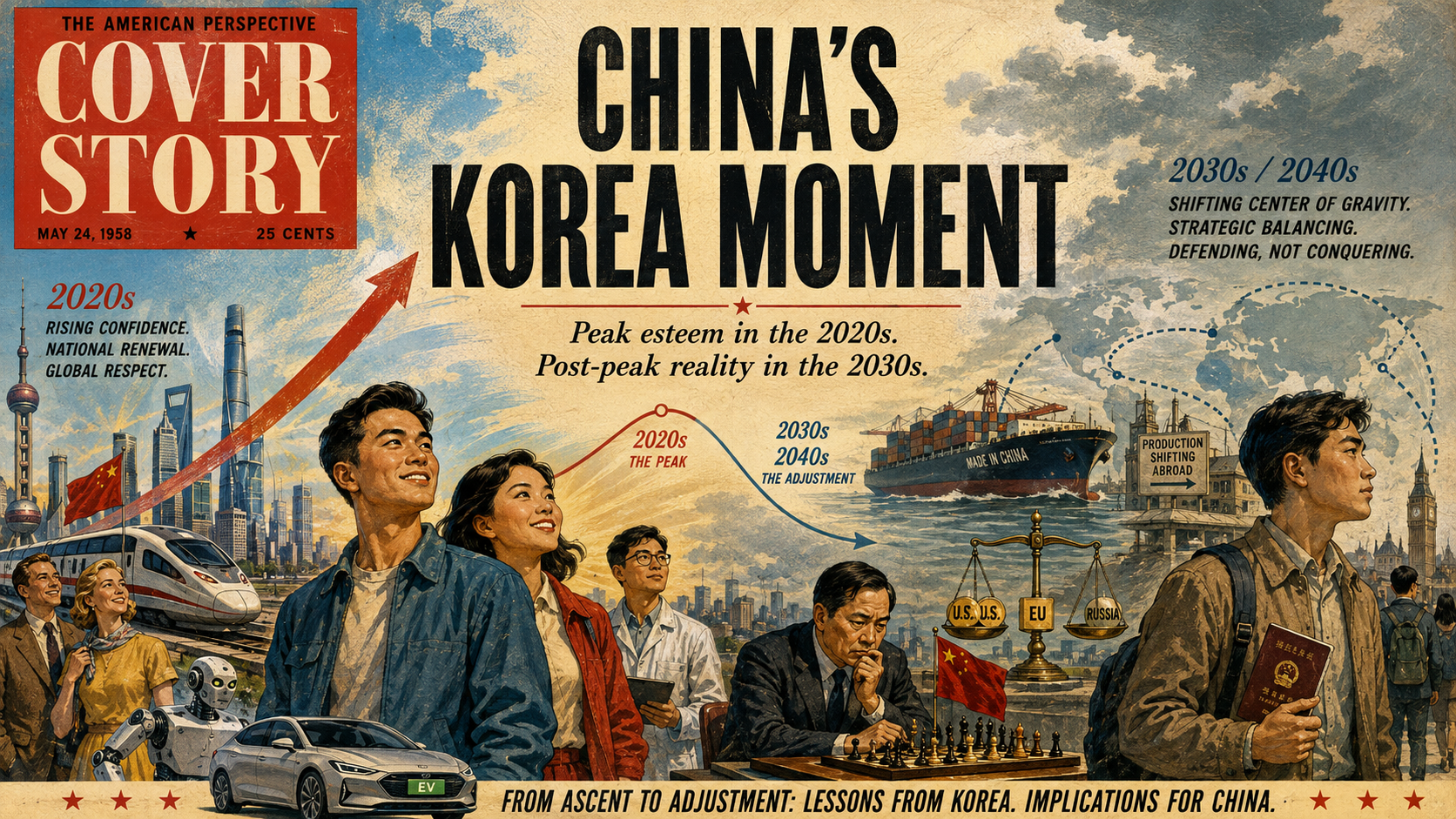
Why China’s 2020s may resemble Korea’s 2010s—and why the 2030s could feel very different
There is a particular national mood that appears near the end of a long ascent.
The country is no longer merely getting richer. Its success starts being reflected back at it by foreigners.
Its companies are no longer dismissed as imitators. Foreign competitors study them. Its cities become places ambitious people want to see. Its technology becomes associated with the future. Its diaspora starts wondering whether leaving was necessarily the upward move. Even cultural products that once seemed provincial begin traveling.
For a while, almost every international comparison seems to move in the same direction.
South Korea had something close to that moment in the 2010s.
China may be having it now.
The analogy I want to make is not that China will become another Korea. China is nearly eleven times Korea’s population, a nuclear power, a permanent member of the UN Security Council, and the world’s second-largest economy at market exchange rates.
The analogy is about the mood around peak relative ascent:
| Peak-esteem decade | Post-peak decade | |
|---|---|---|
| South Korea | 2010s | 2020s |
| China | 2020s | 2030s |
The interesting part is what happens after the mood turns.
Because Korea’s experience suggests that the post-peak period does not begin when factories close or culture disappears.
It begins when success stops hiding dependence.
Korea in the 2010s: 3% growth felt much bigger than 3%
South Korea was already a rich country by 2010. It was not experiencing Chinese-style catch-up growth.
Yet between 2009 and 2019, Korean real GDP still grew by an average of 3.1% a year, versus just 1.8% across the OECD. Korea was mature enough to be taken seriously but still growing quickly enough to keep closing gaps with richer countries.
That was an unusually satisfying position.
Samsung overtook old Japanese electronics champions and became one of the two defining smartphone companies of the era. Hyundai and Kia moved from discount brands toward serious competitors to Toyota and Volkswagen. Korean shipbuilders had displaced Japan. Korean displays and memory chips sat at the technological frontier.
And Seoul itself carried the message.
An American or European arriving in the early 2010s could encounter faster broadband, better mobile infrastructure, enormous subway systems, newer urban districts and Samsung devices everywhere. Korea did not need to explain that it had modernized. You could see it.
Then culture arrived.
Gangnam Style in 2012.
BTS and Blackpink.
K-beauty.
Korean television.
Parasite.
Then, just over the boundary of the decade, Squid Game.
None of these things individually created Korea’s national confidence. What mattered was that industrial, technological and cultural evidence all pointed in the same direction at once.
Japan, Korea’s century-long benchmark, appeared stagnant.
China was gigantic but still clearly below Korea in many high-status technologies.
Europe was struggling through the euro crisis.
America was still recovering from 2008.
Korea kept gaining positions.
That was the essential feeling.
A young Korean could complain about jobs, housing or Korean society and still believe something quite different about the country itself:
Korea will matter more ten years from now than it does today.
That is national ascent.
Korea’s 2020s are the post-miracle X-ray
Now compare that with Korea today.
The country has not collapsed. In fact, 2026 is an unusually strong year because of the AI semiconductor boom.
But the underlying slope has changed dramatically.
Growth was just 1.0% in 2025. The OECD expects the semiconductor cycle to push it temporarily to 2.6% in 2026, then back to 1.9% in 2027. Compare that with the 3.1% average of the pre-pandemic decade.
Korea’s nominal GDP in 2025 was about $1.87 trillion, placing it roughly 13th in the world and accounting for only about 1.6% of global GDP. That is a very successful country. It is not a system-sized economy.
And once growth stops doing the psychological work, that small scale becomes harder to ignore.
The industrial reversal is particularly stark.
Korean battery companies looked like obvious winners of the EV transition only a few years ago. Yet their share of the European EV-battery market fell from nearly 80% in 2022 to 60% in 2024, largely because Chinese manufacturers were gaining. By 2025, Chinese battery producers had moved above 50% of the European market.
Shipbuilding tells a similar story. Korea remains exceptionally strong in LNG carriers and other sophisticated vessels. But China now has roughly 45% of global shipyard capacity and about 60% of the global orderbook. UNCTAD notes that gas carriers are essentially the only major contracting segment in which China did not rank first in 2024.
So the national industrial vocabulary changes.
In 2012:
What can Korea take from Japan next?
In 2026:
Can Korea hold HBM?
Can it preserve high-end shipbuilding?
Can Korean batteries recover against China?
Can Hyundai avoid the fate of European automakers?
The word that quietly enters the conversation is still.
Korea is still world-class in memory.
It is still formidable in shipbuilding.
It still has major battery companies.
That is a different psychology from ascent.
Then the dependencies become visible
The more interesting reversal is not even Chinese competition.
It is that Korea’s 2010s success had created an image of much greater autonomy than Korea actually possessed.
Take finance.
Korea built Samsung, Hyundai, SK Hynix and LG, but it never built a currency or capital market remotely equivalent to its industrial position.
In MSCI’s 2026 market-accessibility review, Korea still lacks a fully deliverable offshore won market. MSCI continues to treat access to Korea differently from developed markets despite decades of industrial success.
Take energy.
Roughly 70% of Korea’s crude oil imports still come from the Middle East. In 2026 Seoul was sufficiently concerned about supply security that it negotiated deeper crude-storage and emergency-supply arrangements with the UAE.
Take America.
The United States increasingly does not simply want to buy Korean industrial products. It wants Korean industry physically located in America.
The current U.S.–Korea economic arrangement involves a Korean investment commitment of roughly $350 billion in the United States—an enormous figure beside Korea’s $1.87 trillion annual economy.
Samsung can become a stronger global semiconductor company by building more fabrication capacity in America.
Hyundai can protect its U.S. market by building cars in Georgia.
LG Energy Solution can become a more important battery company by producing inside North America.
But Korea then has to confront an uncomfortable distinction:
The success of Korean companies is no longer automatically the success of Korean territory.
That is a classic post-peak problem.
And finally there is Japan.
As recently as the 2010s, national ascent made it easier for Korea to imagine that it was gradually escaping its old strategic relationship with Japan.
In 2026, the logic is running the other way.
South Korea and Japan have agreed to deepen cooperation on oil and LNG stockpiles, emergency energy swaps and security, and in August 2026 their officials pledged closer macroeconomic coordination after an unusually coordinated foreign-exchange intervention.
The history did not disappear.
The strategic room did.
That, to me, is the most interesting thing about post-peak Korea.
The country did not suddenly acquire these dependencies in the 2020s.
The rise had made them feel less important. The slowdown makes them visible again.
Now look at China in the 2020s
China today sits in almost the opposite psychological position.
Its economic growth is already slowing, but its international evidence of ascent is still accumulating.
China accounted for 32% of all global manufacturing value added in 2024.
That is not merely first place.
It is more than the United States, Japan, Germany and South Korea combined.
In 2025, China produced nearly 75% of the world’s electric cars. It produced more than 80% of the world’s battery cells. Chinese battery companies supplied almost three-quarters of the batteries deployed in electric cars globally.
Those are extraordinary numbers.
And importantly, they are changing prestige rather than merely production statistics.
BYD is no longer interesting because China can manufacture cheap cars.
Huawei is no longer interesting merely because it survived sanctions.
Chinese AI models are no longer evaluated solely as cheaper imitations of American models.
Chinese drones, batteries, EVs, robots and industrial systems increasingly force foreign competitors to benchmark against China.
That is the Korea-2010s feeling.
The old status assumption—
foreign means technologically superior—
starts breaking down.
And the shift is beginning to show up outside factories.
China recorded 35.2 million foreign visits in 2025, up strongly from the previous year. More than 30 million foreign entries used visa-free policies, up almost 50% in one year.
Meanwhile 495,000 Chinese students returned from overseas study in 2024, up 19.1% in a single year. Since 2012, the Ministry of Education says 5.63 million overseas students have returned.
Even foreign opinion is becoming less uniformly hostile among younger people.
Pew’s 2026 polling found favorable views of China among 61% of Canadians aged 18–34, versus 39% among those over 50. In Britain the split was 54% versus 37%; in France, 51% versus 23%; in Mexico, 70% versus 44%. This is not yet Korean-style cultural affection, and geopolitics obviously distorts the comparison. But it does suggest that younger outsiders are updating their mental picture of China faster than older cohorts.
This is what I mean by peak esteem.
Not that everything inside China is going well.
Not that Chinese people are uniformly optimistic.
And certainly not that China has reached maximum economic power.
It means that around the late 2020s, China may receive the maximum psychological dividend from several decades of accumulated rise.
Foreigners discover the factories after they have already been built.
They discover Shenzhen after it is already rich.
They discover Chinese EVs after the supply chain has already been assembled.
They discover Chinese AI after the research ecosystem has already matured.
Prestige arrives late.
Which is exactly why it can peak just as the underlying growth machine is slowing.
The IMF currently projects Chinese growth falling from 5.0% in 2025 to 3.4% by 2030.
So the China of 2030 could simultaneously be growing at barely one-third of its old miracle-era rate and enjoying the highest international technological prestige in its modern history.
That would be very Korean.
Then comes the 2030s
This is where the analogy becomes more interesting than the standard “India rises, China ages” story.
The IMF has modeled Chinese potential growth at only around 2.8% a year during 2031–40 without major structural reforms, down from roughly 3.8% during 2025–30. It also models a much better reform path, so this is not destiny. But it gives us a plausible baseline for what a post-peak decade actually looks like.
The OECD reaches a related conclusion from another direction: East Asia’s share of global output continues rising until the early 2030s, then begins declining. China drives most of that reversal.
That would make the early 2030s a surprisingly clean candidate for the turn.
And once the turn happens, I think the Korean pattern reappears.
Chinese companies start succeeding outside China
Today, the strange thing about Chinese EV dominance is how Chinese it still is.
In 2024, less than 2% of the electric cars made by Chinese manufacturers were produced outside China.
That will almost certainly change.
The battery industry already shows the direction.
In 2024 China held roughly 85% of global battery manufacturing capacity. Based on committed projects, the IEA expects geographical diversification to reduce that to roughly two-thirds by 2030.
But Chinese ownership does not disappear. In Europe specifically, Chinese companies’ share of battery manufacturing capacity could rise from less than 10% in 2024 to more than 30% by 2030.
That is the post-peak paradox in numerical form.
Chinese firms become more global.
Chinese territory becomes less dominant.
By the 2030s the same logic could spread from batteries into cars, robotics, machinery, solar equipment and electronics.
Europe tells Chinese manufacturers: build here.
Brazil tells them: build here.
Indonesia tells them: build here.
India tells them: if you want this market, localize.
Chinese corporations may comply and prosper.
But China itself captures less of the next factory, the next industrial worker and the next round of capital investment.
Korea is beginning to confront this distinction through Samsung, Hyundai and LG.
China could face it at continental scale.
The export machine stops looking purely like power
China’s enormous trade surplus currently looks like evidence of industrial superiority.
And it is.
But there is another interpretation that becomes more important if domestic growth weakens.
A country that produces far more manufactured goods than its own consumers absorb needs foreigners willing to buy the difference.
The IEA already estimated that Chinese electric-car production exceeded domestic demand by 20% in 2025, helping push Chinese EV exports above 2.5 million vehicles, twice the previous year’s level.
During ascent, this is frightening to everyone else:
China can overwhelm our industries.
During the post-peak period, foreign governments begin recognizing the other side of the bargain:
China needs access to our consumers.
That gives them bargaining power.
Tariffs.
Local-content requirements.
Joint ventures.
Technology conditions.
Investment screening.
Production localization.
The exact instruments will differ by country.
But the structural change is important.
The industrial machine China built to reduce foreign dependence can itself become dependent on foreign market access.
Then China discovers how incomplete its financial ascent was
This may become one of the most psychologically uncomfortable comparisons of the 2030s.
China is already the manufacturing center of the world.
Yet in the third quarter of 2025, the renminbi accounted for less than 3% of global trade settlement, around 8% of trade finance, and only about 2% of global foreign-exchange reserves.
That gap is easy to tolerate when China is growing at 5%, factories are gaining share and capital wants exposure to the Chinese growth story.
It becomes much more conspicuous in a 2–3% growth world.
Imagine China in 2037: still producing perhaps more industrial goods than any country in history, yet Chinese firms and wealthy households still care intensely about access to dollar assets, global financial centers and foreign capital.
Korea built Samsung without building a globally important won.
China may discover that even manufacturing on a superpower scale did not automatically create a Chinese financial system of comparable international weight.
That would be a genuine post-peak revelation.
Resource dependence starts looking different too
China is much more resource-secure than Korea. It has coal, enormous renewable capacity, nuclear power and continental depth.
But the world's largest industrial system consumes resources on a scale no other country has to manage.
Oil and gas from abroad.
Iron ore.
Copper.
Bauxite.
Agricultural commodities.
Feed.
Various specialty minerals.
A large portion arrives across maritime routes extending through the Indian Ocean and beyond.
During the rise, that looks like globalization.
During a period of strategic competition and slower growth, it starts looking more like constraint.
China can build an enormous navy.
It cannot cheaply make the Persian Gulf, Indian Ocean, Southeast Asian sea lanes and every major commodity-producing region politically Chinese.
That difference matters.
The post-peak realization may be:
We became the world’s largest industrial power without becoming sovereign over the global system that feeds that industry.
That is not Korea’s precise problem.
But it is the Chinese equivalent.
And China may suddenly need countries it spent the 2020s intimidating
This is perhaps the closest analogy of all to Korea rediscovering Japan.
An ascending China can afford to imagine that time solves strategic problems.
Japan will eventually adjust.
South Korea will increasingly fall into China’s economic orbit.
Europe cannot afford to decouple.
Southeast Asia will accommodate the regional giant.
American relative power will keep eroding.
But a post-peak China has to calculate differently.
If growth is structurally below 3%, manufacturing is slowly decentralizing, foreign capital has alternatives and the international coalition around China is hardening, then Beijing has more reason to ask:
Can we really afford permanent hostility with Japan?
Can we afford Europe treating China primarily as a security problem?
Can we afford India becoming a permanent strategic adversary?
Can we afford Southeast Asia systematically reducing its reliance on Chinese supply chains?
That is the diplomatic equivalent of Korea needing Japan again.
Nationalist grievances do not disappear.
The country simply has less freedom to indulge all of them simultaneously.
The Korea–China symmetry is sharper than it first appears
Put the two cycles side by side:
| Korea | China |
|---|---|
| 2010s: ~3.1% growth while most rich peers grew slower | 2020s: growth slows, but industrial prestige keeps rising |
| Samsung/Hyundai take positions from old incumbents | BYD/Huawei/Chinese AI take positions from old incumbents |
| Seoul gains “future city” prestige | Shenzhen/Shanghai/Hangzhou gain similar prestige |
| Korean culture suddenly travels | Chinese cultural prestige may begin catching up later |
| Overseas Koreans can plausibly return into an ascending country | Returnees already number roughly half a million annually |
| 2020s: growth falls toward ~1–2% underlying range | 2030s: IMF baseline potential growth around 2.8% |
| China takes Korean batteries, displays, shipbuilding scale | Other countries begin forcing more Chinese production offshore |
| Korean champions increasingly invest abroad | Chinese champions become true multinational producers |
| Won looks weak beside Korea’s industrial sophistication | RMB may look weak beside Chinese industrial sophistication |
| Imported energy becomes strategic vulnerability | Imported resources and maritime access become strategic constraints |
| U.S. security and market leverage become harder to ignore | Foreign markets and balancing coalitions gain leverage over China |
| Korea needs Japan despite historical grievance | China needs workable relations with states it expected to bend |
| The question becomes “what can we hold?” | The question becomes “how much of the peak can we preserve?” |
This is why I think the analogy is more useful than another demographic forecast.
We already know China is aging.
We already know India will become larger.
Those observations tell us remarkably little about what post-peak China will feel like.
Korea gives us a more interesting model.
The post-peak decade is the decade when a country discovers that many of the powers it thought it had acquired were actually conditional.
Industrial power depended on markets.
Corporate power did not guarantee domestic production.
Manufacturing strength did not create monetary power.
Technology did not create energy independence.
Military capability did not eliminate alliance or geopolitical constraints.
And historical antagonisms that felt affordable during ascent suddenly become expensive.
That is what Korea’s 2020s are beginning to reveal.
The real change is the question people ask
A Korean in 2013 could reasonably ask:
How much more important will Korea be in ten years?
A Korean in 2026 increasingly has reason to ask:
Which parts of Korea’s current position can we still hold in ten years?
That is the turn.
China may cross it in the early 2030s.
A Chinese person in 2027 can still plausibly look ten years ahead and assume that China will be more technologically important, more industrially dominant and harder for other countries to resist.
By 2037, the psychologically characteristic question may be different:
How much of what we achieved by 2030 can we preserve?
China does not have to collapse for that to happen.
Its cities can remain magnificent.
Its companies can remain globally important.
Its military can continue getting stronger.
Its culture may actually become more internationally influential.
Its citizens can keep getting richer.
Relative decline requires something much simpler:
ten years stop reliably making China more powerful relative to everyone else.
Once that happens, the entire interpretation of the country changes.
A factory moved overseas is no longer merely globalization. It looks like hollowing out.
A wealthy family moving assets abroad is no longer merely diversification. It looks like lost confidence.
A compromise with Japan is no longer tactical pragmatism. It looks like reduced room for maneuver.
Dependence on foreign markets is no longer proof of export strength. It becomes vulnerability.
And a technological sector China merely retains no longer feels like another conquest.
It becomes something that must be defended.
That is what I mean by China’s Korea moment.
The 2020s may be the decade when China receives the maximum prestige dividend from forty years of ascent. The 2030s may be the decade when it discovers just how many of the apparent freedoms created by that ascent were never entirely its own.